Traditional casting and CNC machining have long dominated dental metal restoration production, but both carry limitations: time-consuming workflows, reliance on technician skill, and material waste.
To change this situation, many dental labs and clinics are shifting to metal 3D printing, hoping to gain a simplified workflow and reduce costs.
If you are searching for the right dental metal 3D printer, it requires a clear understanding of your own needs and the technical parameters involved. This article covers 10 key factors to help dental labs and clinics make informed decisions.
What is a Dental Metal 3D Printer?
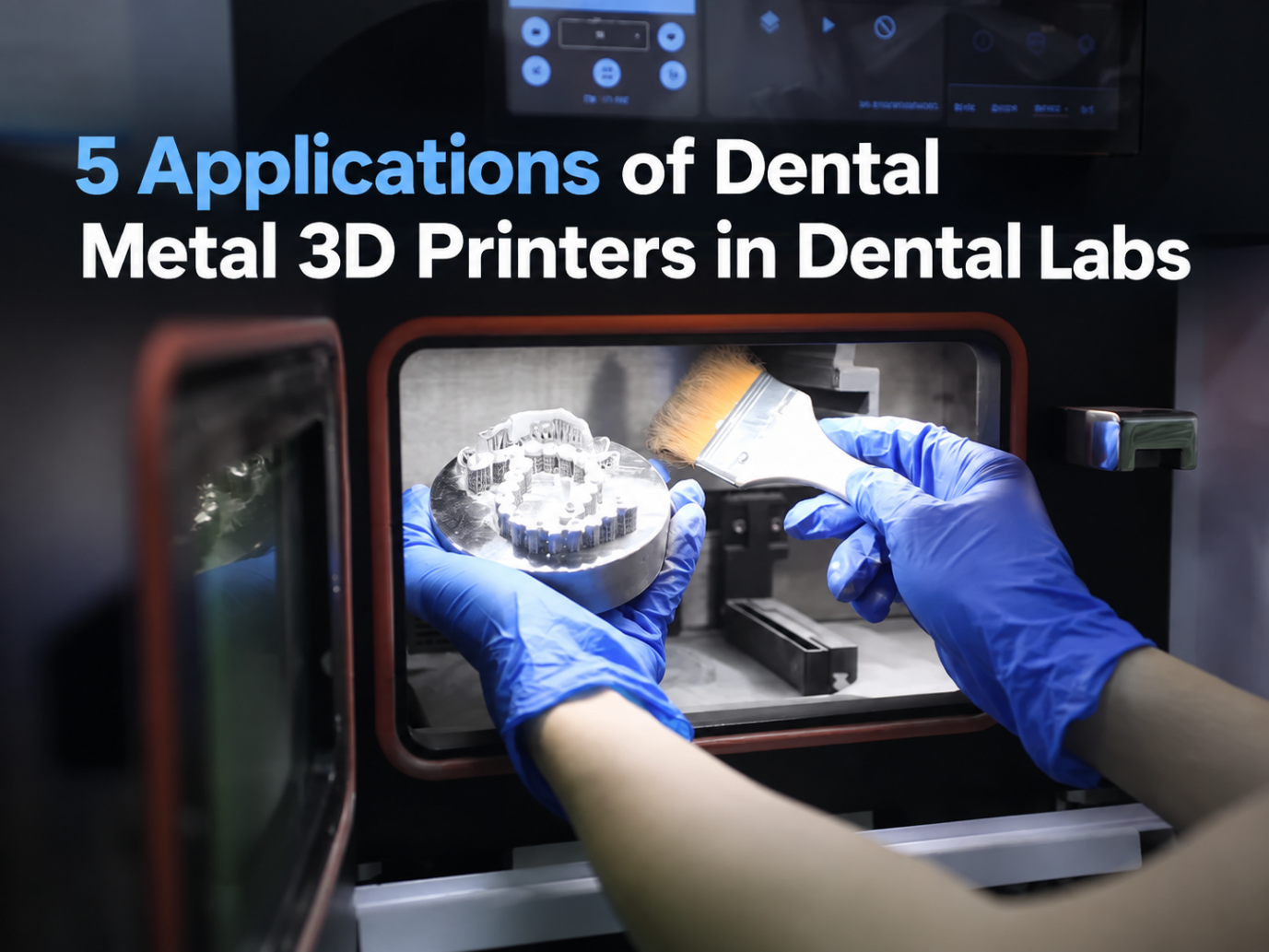
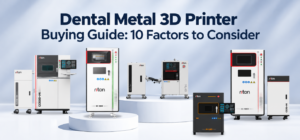
A dental metal 3D printer is an additive manufacturing machine that uses a high-energy laser to selectively melt or sinter fine metal powder layer by layer into dense dental restorations.
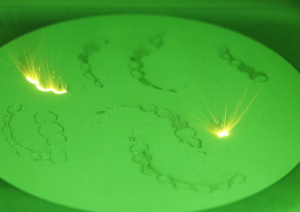
The process starts with a digital design file. The printer spreads a thin layer of metal powder across a build platform, then fuses it with a focused laser beam. This cycle repeats until the complete part is formed.
Common materials include cobalt-chromium (CoCr) alloys, titanium (Ti), and nickel-chromium (NiCr) alloys. The finished parts can serve as crowns, bridges, partial denture frameworks, implant abutments, and orthodontic frameworks.
Advantages of Dental Metal 3D Printing
Dental metal 3D printing delivers several advantages for labs and clinics:
- High precision: Layer-by-layer fabrication achieves micron-level dimensional accuracy, meeting the tight tolerances required for dental prosthetics.
- Stable material properties: Laser melting produces parts with consistent density and mechanical strength. The resulting microstructure eliminates porosity and shrinkage defects.
- Customization: Every restoration is patient-specific. A dental 3D printer builds each unit directly from individual scan data.
- Reduced material waste: Additive manufacturing uses only the powder needed for the part, and unfused powder is recyclable.
- Improved production efficiency: Multiple units print simultaneously in a single build cycle. A capable metal 3D printing machine, such as Riton M-200D, can produce 430 crowns in 5.5 hours.
- Suitability for batch production: Because the build platform accommodates many parts at once, production costs per unit decrease significantly at higher volumes.
How to Choose Dental Metal 3D Printers?
In fact, many laser metal 3D printers on the market share some similarities. It is important to consider the following aspects:
1. Your Dental Applications
Start by defining the restorations you plan to produce. Different applications demand different capabilities.
- Crowns and bridges require high accuracy and smooth surface finishes.
- Partial denture frameworks and orthodontic appliances need a larger build area and strong material density.
- Implant components, including custom abutments and bars, demand both precision and biocompatibility.
If most parts are small, a compact machine can be sufficient. If the laboratory routinely nests larger frameworks or is busy every day, a larger system provides better production efficiency.
2. Printing Technology: SLM vs DMLS vs SLS
SLM, DMLS, and SLS are three common metal 3D printing technologies. They are different:
Technology | Basic Principle | Purchasing Consideration |
SLM | The mainstream tech; Laser energy melts metal powder to form dense metal layers. | Widely applied to Co-Cr and titanium dental manufacturing. |
DMLS | Laser-based metal powder bed fusion; terminology varies among manufacturers. | Check the actual fusion process, materials, and validated parameters. |
SLS | Uses laser energy to sinter powder rather than fully melting it. | Verify whether the system is designed and validated for the required dental metal application. |
For most dental labs and clinics, SLM provides the density, accuracy, and material compatibility that dental restorations require.
3. Printing Accuracy
Accuracy directly determines restoration fit and marginal adaptation. Especially for full-arch restorations, even minor errors can cause passive fit failure.
Key parameters include spot diameter and layer thickness. Layer thickness is typically adjustable between 20-60μm. Thinner layers produce finer surfaces and higher dimensional accuracy, but extend print time.
How to evaluate: Ask suppliers for accuracy inspection reports on actual printed samples, not just specification sheets.
4. Printing Speed
Speed affects your lab’s throughput and delivery timelines. Evaluate speed in two ways: scanning speed (how fast the laser moves across the powder bed) and total cycle time (how long a full build takes from start to finish).
High-performance machines reach scanning speeds above 14,000 mm/s. Dual-laser systems can double throughput by processing two areas of the build platform simultaneously.
5. Material Compatibility
A dental metal 3D printer should support at least the following materials:
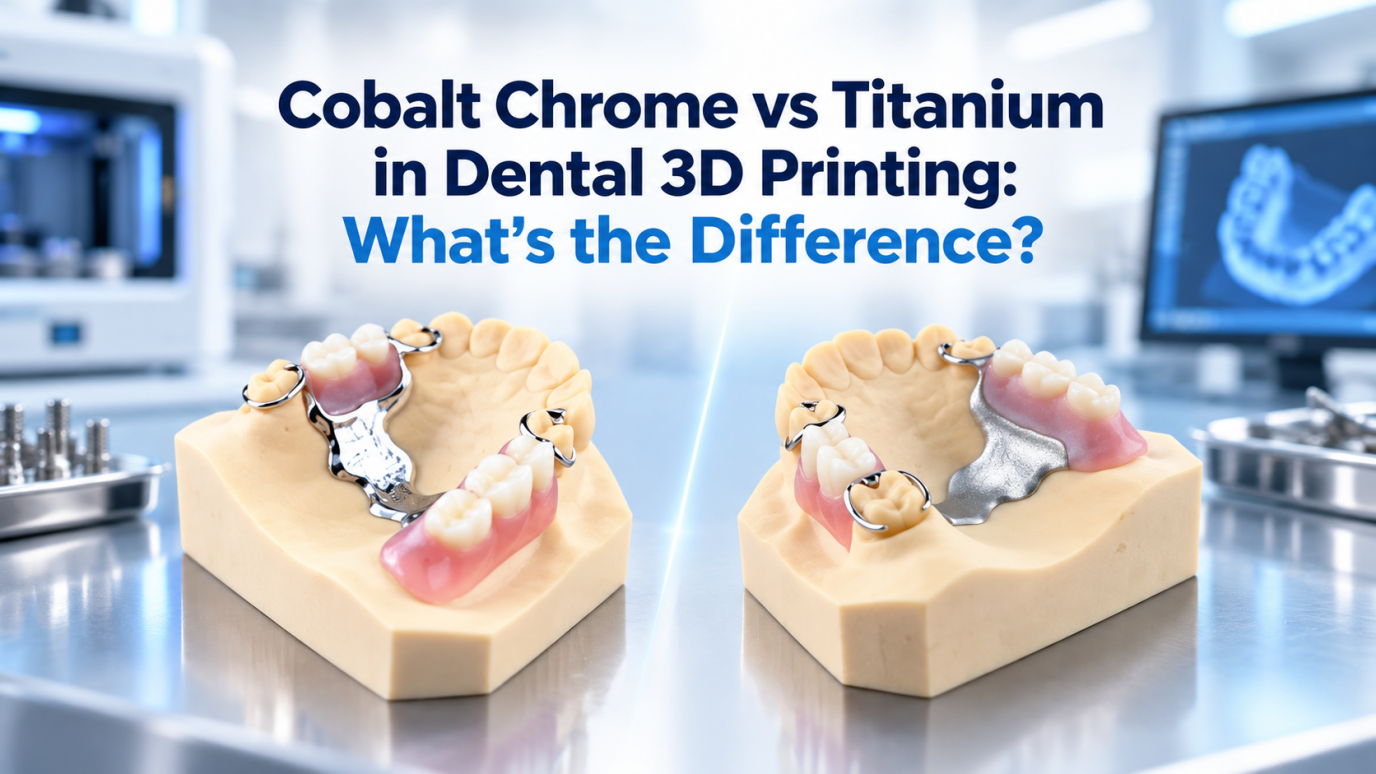
- Cobalt-chromium (CoCr) alloys, which account for the majority of metal dental prosthetics.
- Titanium is essential for implant restorations due to its biocompatibility and corrosion resistance.
- Nickel-chromium (NiCr) alloys provide a lower-cost alternative for non-implant restorations.
- Stainless steel may serve niche applications in temporary frameworks.
Confirm whether the printer uses an open or closed material system. Open systems accept third-party powders, giving you flexibility on material sourcing. Closed systems lock you into the manufacturer’s proprietary powders, which come with validated parameters and quality.
6. Surface Quality and Post-Processing
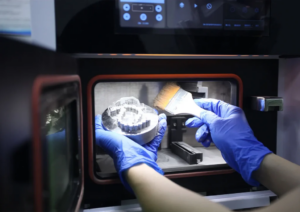
Metal 3D-printed restorations are not ready to use straight out of the machine. Support removal, surface grinding, and polishing directly affect final quality.
Surface roughness is influenced by powder particle size, layer thickness, and laser parameters. Finer powder and thinner layers generally produce better surface quality.
Post-processing convenience should be factored in. Most manufacturers also provide post-processing equipment, such as polishing machines.
7. Build Size
Build volume, measured as the width and depth of the printable area, determines how many parts you can produce per cycle.
For dental applications, most parts are small. A build platform of 100×80mm can be enough for small clinics and labs.
Larger build volumes increase batch productivity. However, they also increase machine cost and the physical footprint in your lab. Match the build size to your production volume.
8. Laser Power
Laser power determines how effectively the printer melts metal powder.
Higher power provides faster melting speeds and more consistent fusion of each layer. Dual-laser configurations further boost throughput by processing two regions of the build platform at once. This setup is particularly beneficial for high-volume dental labs.
9. Compliance and Certification
Dental restorations are medical devices. Dental metal 3D printers and materials must meet regulatory standards.
Key certifications include:
- CE: Confirms the device meets EU health, safety, and environmental requirements.
- FDA: Required for machines producing Class II medical devices, which includes most dental prosthetics.
- ISO 13485: Quality management system standard for medical device manufacturers.
- ISO 9001: General quality management certification.
- Material biocompatibility standards (ISO 10993, ISO 22674): Ensure that printed materials are safe for long-term intraoral use.
- RoHS: Ensure that the product does not pose a threat to the environment and human health.
10. Total Cost of Ownership
The purchase price of a dental 3D printer represents only a portion of the total investment. A complete cost analysis should include:
- Dental metal 3D printer cost
- Metal powder costs
- Maintenance for laser sources, optical components, and filtration systems.
- Post-processing equipment, such as polishing machines.
- Facility requirements. Some machines require dedicated ventilation and inert gas supply (argon or nitrogen).
Where to Buy Dental Metal 3D Printers?
Wanting to invest in dental metal 3D printers? You need a reliable partner.
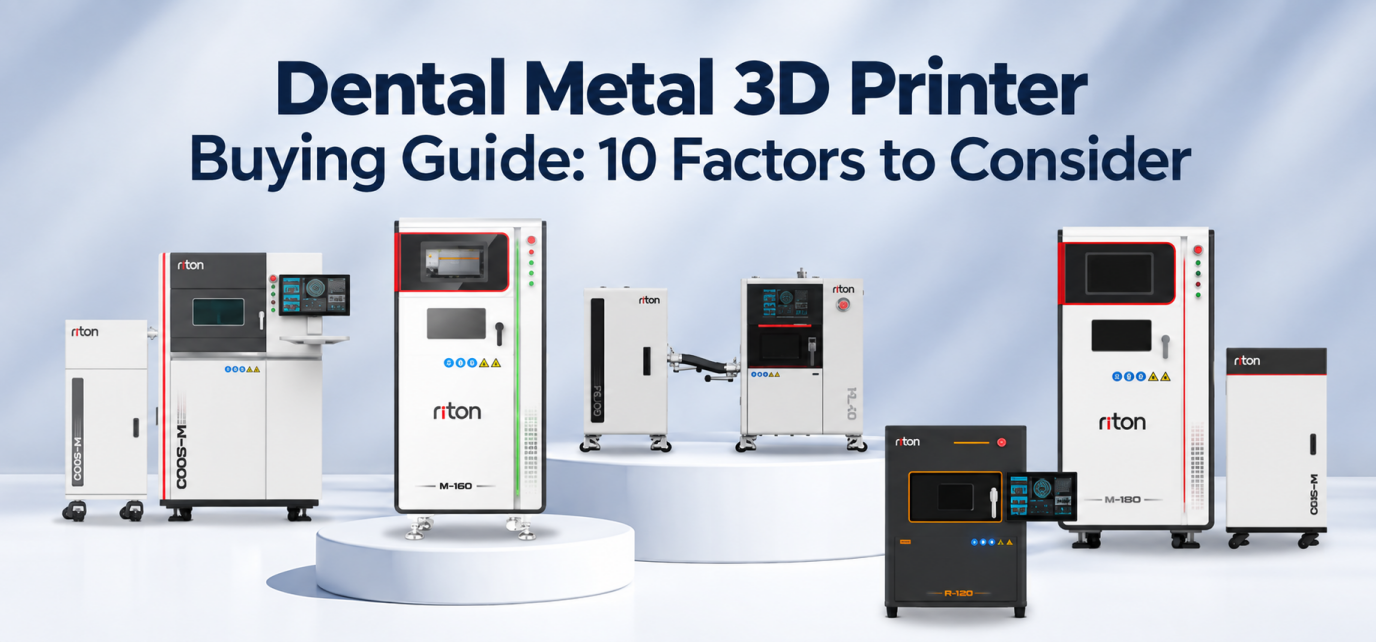
Riton is a dental-focused metal 3D printer manufacturer, founded in 1997. The company designs and produces SLM metal 3D printers specifically for digital dentistry workflows. Here are four models that cover the range of dental lab needs.
Model | Laser | Build Area | Productivity | Suitable for |
250 W single-fiber laser | 100 × 90 mm | Up to 100 crowns or 7 frameworks in 2.5 hours | Compact labs and smaller production environments | |
300 W / 500 W single-mode fiber laser | 100 × 80 mm | Focuses on desktop batch production | Labs prioritizing compact operation and material handling | |
≤500 W single-fiber laser | 150 × 140 mm | 200 crowns or 17 frameworks in 4.5 hours | Medium to higher-volume dental production | |
Dual fiber lasers, ≤500 W each | 220 × 150 × 140 mm | 430 crowns or 35 partial frameworks in 5.5 hours | High-volume production centers |
These machines can handle CoCr alloy, titanium alloy and NiCr alloy, and have been certified by CE, FDA, ISO, RoHS, FCC, and IC.
The Riton controller enables clinics and labs to conduct online intelligent monitoring of the overall machine status, flexibly edit print content, and track and record printing progress in real time. It features a simple interface design, reducing the operator’s learning cost.
To explore specifications and request a quote, feel free to contact Riton now.