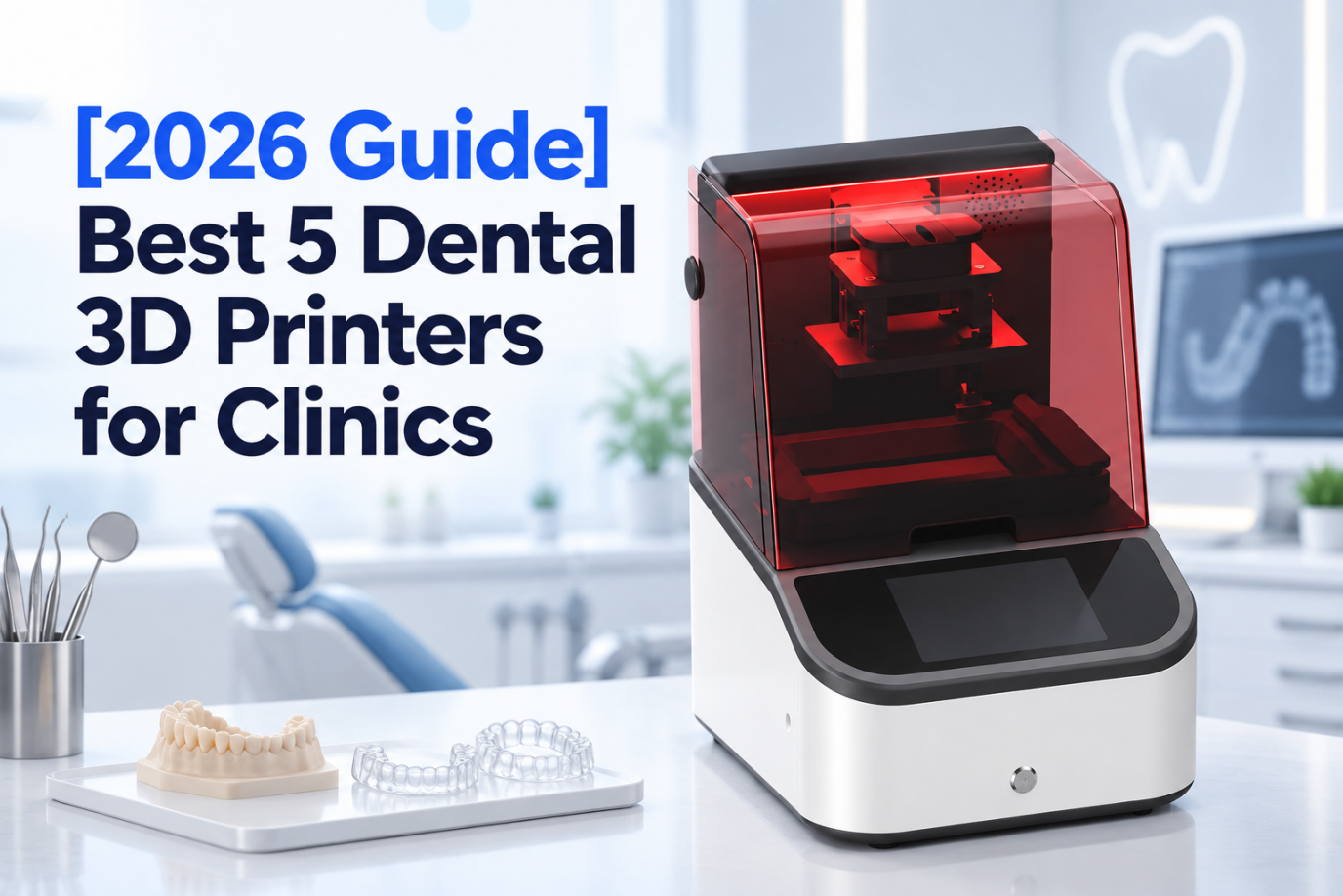
A dental laboratory does not print resin simply to create a three-dimensional object. The real purpose is to turn digital dental data into a physical model, guide, appliance component, or restoration-related part with a repeatable manufacturing process.
A resin dlp 3d printer performs this conversion through digital light projection. Instead of forming each feature manually, the system selectively cures photosensitive resin layer by layer. That makes DLP technology particularly relevant to laboratories handling digitally designed dental products.
What a DLP Printer Actually Does in a Dental Workflow
Digital dentistry starts with information rather than a physical workpiece. An intraoral scan, laboratory scan, or CAD design can produce a digital file representing the required geometry. That information must eventually become a physical object for inspection, fabrication, treatment, or further processing.
DLP printing provides the manufacturing step between those two states. The printer uses projected light to cure selected areas of liquid resin. Repeating this process across successive layers gradually creates the complete geometry.
At Riton, our RXDent-D130 is specifically configured around DLP projection. Its published specifications include a 1920 × 1080 resolution, 30 μm XY accuracy in the product brochure, and adjustable layer thickness from 0.01 to 0.2 mm.
Consequently, the machine’s function is not limited to producing generic prototypes. Its purpose within a dental environment is to provide a controlled way to manufacture specific resin-based dental outputs from digital designs.
How DLP Converts Dental Data Into Physical Parts
The operating principle is straightforward. Liquid photosensitive resin is placed in the resin tank, and the DLP system projects light onto the required areas of each layer. Exposed resin undergoes photopolymerization and becomes solid.
Layer thickness determines how the digital geometry is divided vertically. The RXDent-D130 supports a range of 0.01–0.2 mm, allowing the printing setup to be selected according to the intended production requirements. Its stated printing speed is 1–6 seconds per layer in the supplied brochure.
Once printing is complete, the physical part still requires appropriate post-processing. Our resin printing workflow describes cleaning with isopropyl alcohol, UV curing, support removal, and surface smoothing as subsequent steps.
The significance of DLP is therefore not just the light source. It is the combination of digital geometry, controlled exposure, layer formation, and subsequent processing that creates a usable dental component.
Why One Printer Can Serve Different Laboratory Tasks
Dental laboratories produce more than one type of resin object. A digital workflow may require diagnostic models, orthodontic models, surgical guides, denture-related components, or other products depending on the laboratory’s services.
The RXDent-D130 brochure lists models, clear-aligner models, occlusal guards, dentures, surgical guides, try-in dentures, crowns and bridges, veneers, inlays, and onlays among its intended fabrication areas.
Such versatility explains the practical purpose of a dlp resin 3d printer in a laboratory. Instead of dedicating the equipment to a single type of output, the same printing platform can support different digital production tasks when the appropriate resin and workflow are used.
Material selection remains essential. We separately offer dental-specific UV-curing resin categories including dental model, surgical guide, gingiva mask, casting wax, IBT, splint, try-in, denture base, tray, temporary model, crown, and denture teeth materials.
The printer and resin should therefore be considered as part of one production system rather than as independent purchases.
Where the RXDent-D130 Fits in Dental Production
Our Riton RXDent-D130 is positioned around stability, automation, and production control. Its product documentation describes automatic resin replenishment, dual-tank switching, environmental control, tension sensing, and automatic light-source calibration.
Its dual-tank configuration is particularly relevant to workflow flexibility. The supplied specifications identify a large tank forming size of 130 × 70 × 120 mm and a small tank size of 60 × 60 × 120 mm. This gives operators two available forming configurations rather than requiring one fixed tank size for every job.
The equipment is also relatively compact. Published dimensions are 420 × 320 × 500 mm, with a net weight of 20 kg. Printing can be initiated through wireless or USB methods, while the system uses a 7-inch HD color touchscreen.
These characteristics define its role more clearly than the term “DLP” alone. The machine is intended to make resin-based digital dental production more structured and manageable inside a laboratory environment.
What Its Purpose Means for a Digital Dental Lab
The practical purpose of resin dlp 3d printer technology is to shorten the distance between digital dental design and physical production. A laboratory can receive digital information, prepare the file, print the required geometry, and continue with the relevant post-processing steps.
That function becomes especially valuable when multiple dental products must be produced from digital files. Models, guides, trays, try-ins, and other resin-based outputs can enter the same general digital manufacturing workflow, while the selected resin determines the material-specific application.
Rather than treating DLP specs in isolation, we position the RXDent-D130 specifically for integrated digital production. Features like its advanced DLP projection, flexible layer heights, dual-tank layout, and automated status tracking work together to streamline dental laboratory manufacturing.
The role of a dental DLP system is clear-cut: it converts virtual scan data into exact physical components using precise photopolymerization. For any lab building out a digital ecosystem, this makes resin DLP technology a practical part of a digital dental manufacturing workflow rather than a mere prototyping gadget.