Which method serves your dental lab better: pliers or a machine? Orthodontic wire bending shapes stainless steel wire into parts for appliances such as Hawley retainers, space maintainers, and lingual arches.
Technicians have long done this by hand, so quality depends on personal experience. Although this approach allows fine adjustments, production speed is unstable. Digital dentistry now offers an alternative: the automatic wire bending machine.
For dental labs, what are the differences between manual and automatic wire bending? And what automation changes for labs?
How Do Manual and Automatic Orthodontic Wire Bending Work?
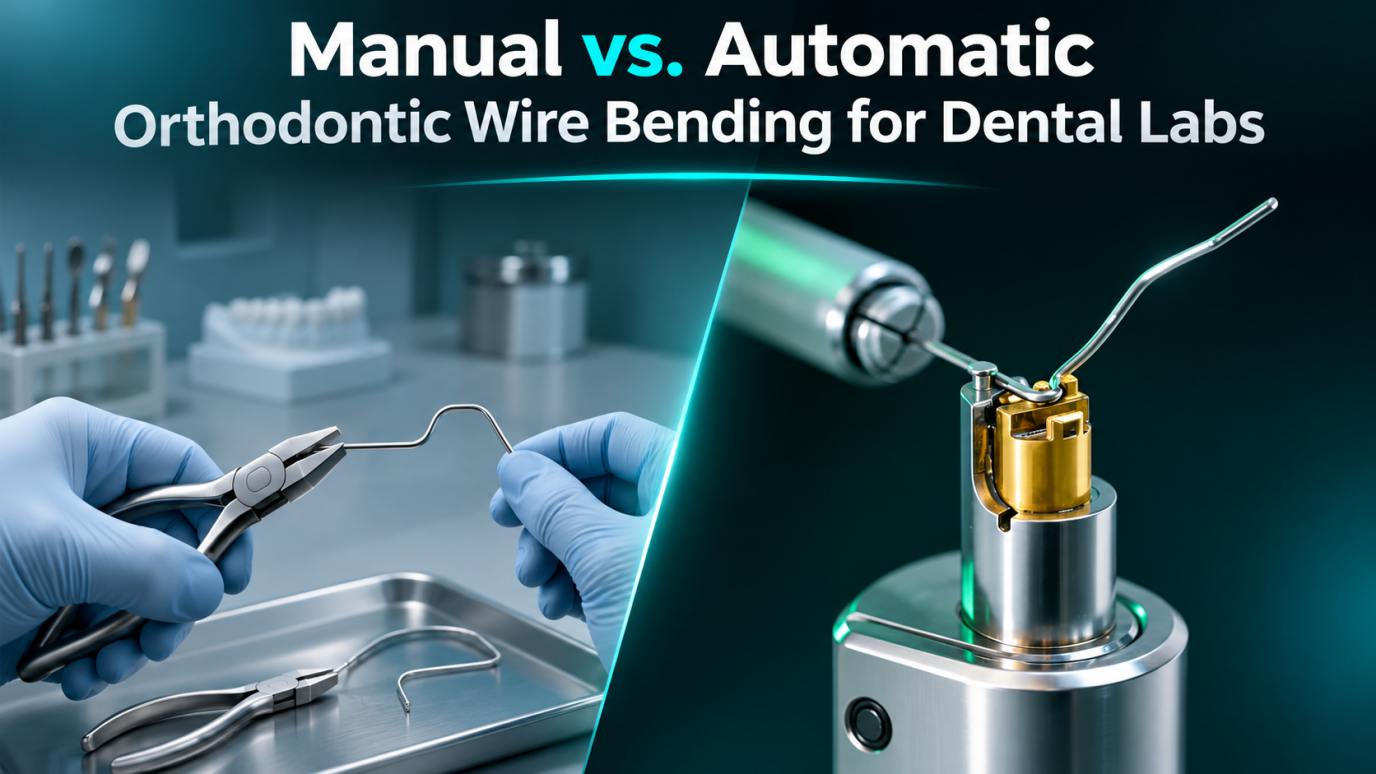
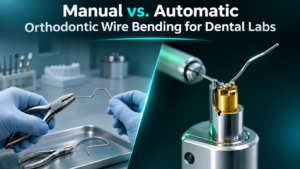
Manual bending depends on direct technician control, while automatic bending uses digital designs and programmed machine movements.
1. Manual Orthodontic Wire Bending
Manual orthodontic wire bending involves shaping orthodontic wires using hand-operated instruments, such as bird-beak, three-prong pliers, and flat-nosed pliers.
The process typically begins with preparing a physical dental model. The technician then measures the required wire length, identifies bending points, and manually forms the wire into the desired shape. They compare the wire with the model after each bend, repeating small corrections until the wire seats correctly.
Advantages:
- Fine adjustment: Technicians can modify individual bending points and angles directly to ensure final positioning.
- Personalized adaptation: Experienced technicians can accommodate complex tooth arrangements and appliance requirements.
- Flexible production: Manual tools are relatively simple to operate.
2. Automatic Orthodontic Wire Bending
Automatic wire bending combines CAD/CAM with an automatic wire bending machine.
Technicians first import the patient’s digital dental model into compatible design software, where they create the required wire structure and adjust it personally. The software then generates and optimizes the bending path before sending instructions to the wire bending machine. The machine automatically shapes the wire according to the digital design. After bending, technicians inspect the finished component and make any necessary adjustments.
Advantages:
- Standardization: Digital designs and programmed bending paths produce the same bent orthodontic appliance wire components.
- Repeatability: Automated mechanical control can reproduce the same wire shape according to the design file.
- Rapid production: Automated feeding and brace wire bending reduce the technician’s time spent on repetitive manual operations, so they can handle more complex cases and higher-value output.
Manual vs. Automatic Orthodontic Wire Bending: Key Differences
The main difference between manual and automatic ortho wire bending lies in how wire shape is designed, formed, and reproduced. Manual production relies on individual craftsmanship, whereas automated production uses digital instructions and machines.
Comparison | Manual Wire Bending | Automatic Wire Bending |
Time cost | Requires shaping, adjustments and inspection. Production time varies with complexity, typically 20-30 minutes. | Automates repetitive bending operations, completing a single piece in under 15 minutes, with support for batch mode. |
Labor cost | Requires experienced technicians, and the training period is long with high costs.
| A beginner can typically operate the machine in just 3 days, allowing technicians to focus on fine adjustment. |
Precision | Depends on individual skills, and the precision of repetitive bending cannot be guaranteed. | Uses programmed bending paths and controlled mechanical movements to improve consistency and repeatability. |
Design method | Primarily relies on physical models and manual measurements. | Uses 3D models, CAD design, and AI optimization. |
Doctor-patient communication | Often relies on physical models, photographs, and written instructions. | 3D visualization solutions intuitively display the results, enhancing trust and communication efficiency. |
What Improvements Do Automatic Wire Bending Machines Bring to Dental Labs?
Automatic bending does not eliminate the need for experienced technicians. Instead, it improves workflow efficiency and process consistency.
By reducing repetitive manual tasks, laboratories can allocate experienced technicians to appliance design, inspection, and complex adjustments. Digital records also improve traceability and help reduce communication errors.
Orthodontic Wire Bending Workflow for Dental Labs
Automated wire bending can be divided into 5 steps:
Step 1: Model Input
The clinic sends an intraoral scanning file, or the lab scans a plaster model. The lab uploads the file to the design platform.
Step 2: Steel Wire & Base Design
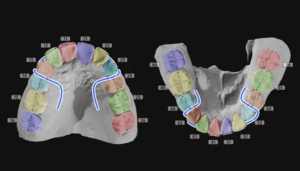
In the design software, select the appliance type; the system generates the wire shape automatically, or a designer fine-tunes the path manually. The base is designed in parallel to ensure correct fit between wire and base.
Step 3: Steel Wire Bending / Base Printing
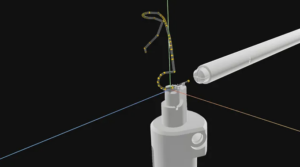
Design data goes straight to the bending machine, which completes archwire feeding, bending, and cutting. The base is produced simultaneously by a 3D printer. This greatly improves lab efficiency. Desktop devices such as the Riton WBM-G1 offer wire-feeding precision of ±0.1 mm and accommodate 0.7 to 1.0 mm wire, enough to cover most appliance structures.
Step 4: Assembly and Post-Processing
Technicians assemble the bent wire onto the printed base, perform simple manual trimming, and round and polish the wire ends. This prepares it for proper clinical use.
Step 5: Clinical Use
The lab ships the finished appliance, and the doctor fits it in the patient’s mouth and adjusts it if needed. Because the design is stored digitally, the lab can reproduce the same wire if a patient loses or accidentally damages the appliance.
In the traditional model, bending technicians work independently. With automatic bending, one wire bending machine, one designer, and one wire-adjustment technician can cover the output previously produced by three technicians.
Experienced technicians are freed from repetitive bending labor and move to complex case adjustment and other high-value output work.
Upgrade Your Dental Lab with Riton Wire Bending Solutions
If your dental labs are planning automated ortho wire bending, Riton provides automatic orthodontic wire bending machines designed to connect digital design with wire manufacturing. Our product range includes the WBM-V2, WBM-G1, and WBM-T1, serving different production environments and wire requirements.
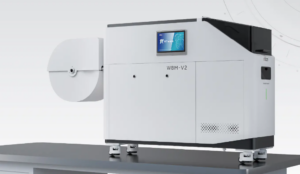
1. Riton WBM-V2 Automatic Orthodontic Wire Bending Machine
Riton WBM-V2 is the mainline model for batch production in labs. It accommodates 0.5 to 1.0 mm orthodontic stainless steel wire, with wire feeding precision of ±0.05 mm and bending repeatability of ±0.5°; a routine labial bow is bent within 60 seconds.
The device connects directly to the Riton Cloud and OrthoWireLab platform, with one-click design data delivery, and supports many-to-many interconnection between devices and the platform.
For labs with larger daily volume pursuing capacity and consistency, this is the core choice.
2. Riton WBM-G1 Desktop Automatic Orthodontic Wire Bending Machine
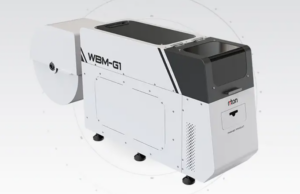
More compact, weighing about 40 kg with a power consumption of 500 W, the WBM-G1 accommodates 0.7 to 1.0 mm wire with wire feeding precision of ±0.1 mm.
While retaining the AI path algorithm and direct software connection, it meets the needs of small and medium labs or early-stage digitalization with a lower footprint and power draw.
If lab space is limited, the WBM-G1 is the more practical entry point.
3. Riton WBM-T1 Desktop Intelligent Twisted Wire Bending Machine
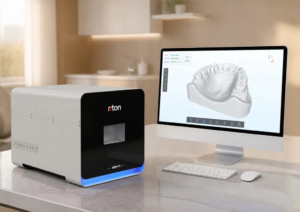
Riton WBM-T1 specializes in twisted wire form chairside scenarios. The machine is close to A4 paper in size and weighs under 5 kg, supporting common three-strand and six-strand 0.45 to 0.55 mm twisted wire.
After intraoral scan data import, AI automatically plans the path, and a single archwire is completed in about 15 minutes; the device features an AI visual closed-loop control system for real-time correction.
For clinics that want to keep twisted-wire retainer fabrication in-house, or labs that need to provide rapid chairside support to partner clinics, the WBM-T1 is your preferred automatic bending solution.
Conclusion
Overall, manual bending remains useful for specialized adjustments and finishing work. However, as dental labs handle increasing numbers of orthodontic appliances, automatic wire bending offers a more efficient approach to repetitive production.
If your labs or clinics are looking to incorporate automated orthodontic wire bending, contact Riton now for more details and to choose a suitable one.