Dental laboratories increasingly depend on digital workflows to produce models with greater consistency and detail. Yet accurate results do not come from resin alone. We need to consider the printer, optical resolution, molding area, material compatibility, and post-processing workflow together. For us, UV resin 3D printing starts with selecting equipment capable of translating digital dental data into precise physical models with repeatable quality.
How UV Resin 3D Printing Creates Dental Models
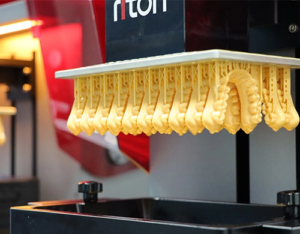
UV resin printing uses liquid photosensitive resin that reacts when exposed to ultraviolet light. During production, the resin is selectively cured layer by layer, gradually forming a solid model from the digital design. After printing, the model normally requires cleaning, UV post-curing, support removal, and surface finishing.
This workflow makes the technology suitable for dental applications where complex geometries and fine details need to be reproduced efficiently. We design our resin 3D printers specifically for dental production, with equipment and materials developed around applications such as dental models, surgical guides, gingiva masks, splints, try-ins, denture bases, and trays.
Why Printer Resolution Matters to Dental Accuracy
When we discuss accuracy, we cannot evaluate the resin separately from the printer’s optical system. Pixel size and resolution determine how finely the printer can represent the digital geometry during layer exposure. A suitable system therefore needs to provide sufficient resolution for the specific dental application.
Our RXDent-L230 provides a 228 × 128 × 150 mm molding size, a 30 μm pixel size, and 7680 × 4320 pixel resolution. This combination gives dental laboratories a substantial working area while maintaining fine pixel-level control. For production teams, the larger molding area can also support multiple models within a single print cycle.
Matching the Dental Resin 3D Printer With the Material
A dental resin 3D printer is only as effective as the resin selected for the intended application. Different dental components have different requirements for dimensional stability, hardness, flexibility, strength, wear resistance, and surface characteristics. We therefore develop application-specific resins rather than expecting one material to perform identically across every workflow.
Our Model V1.0 is a dental photopolymer material for producing dental models. It is compatible with LCD/DLP equipment operating at 385–405 nm and is designed for fixed prosthodontics. This material features a hardness of ≥82 Shore D, water absorption of ≤1.2%, and a bending strength of 70–80 MPa.
Surface Quality Supports Downstream Workflows
Fine dimensional detail is important, but surface quality also influences how efficiently dental teams can inspect, process, and use printed models. Rough or inconsistent surfaces can increase finishing requirements and potentially obscure important anatomical details.
We therefore focus on a combination of printer precision and resin characteristics. Riton describes Model V1.0 as providing precise detail reproduction, excellent surface texture, dimensional stability, and fast molding. These properties are particularly relevant for laboratories producing models used in fixed prosthodontic workflows where accurate reproduction of the digital design is essential.
Production Speed Must Work With Accuracy
High precision has limited commercial value if production becomes too slow for a laboratory’s workload. We consequently balance resolution with molding capacity and printing efficiency. For business dental operations, this balance can influence turnaround times, equipment utilization, and overall production planning.
Riton offers both the RXDent-L230 and RXDent-D130 resin printers for dental applications. The RXDent-D130 provides a 130 × 70 × 120 mm molding size, while the RXDent-L230 is designed for larger-scale, high-precision production. This range gives laboratories an opportunity to select equipment according to case volume, workspace, and production objectives.
Post-Processing Is Part of the Accuracy Equation
Printing is only one stage of the manufacturing process. After UV curing, we need to remove uncured resin, complete post-curing, and remove supports without damaging important features. A consistent post-processing procedure therefore contributes to the final model’s dimensional and surface quality.
Our recommended workflow includes cleaning printed models with isopropyl alcohol, followed by UV curing and final support removal and surface finishing. We also provide dedicated auxiliary equipment for dental resin workflows, including the RXDent-W150 ultrasonic cleaner, which is designed for efficient removal of uncured resin from printed dental parts.
Building a Reliable Dental Printing Ecosystem
For us, choosing equipment is not simply a matter of comparing resolution numbers. We look at the complete system: printer architecture, compatible wavelengths, application-specific materials, molding capacity, post-processing, and technical support. A well-matched ecosystem makes it easier for dental laboratories to establish repeatable production procedures.
Riton‘s resin portfolio extends across dental models, surgical guides, gingiva masks, casting wax resin, IBT, splints, try-ins, denture bases, trays, crown bridges, crowns, and denture teeth. This application-focused range allows laboratories to select materials according to the specific production task rather than forcing different applications into one resin formula.
Choosing the Right Printer for Precision Dentistry
Accuracy starts before the first layer is cured. We believe dental laboratories should evaluate pixel size, resolution, molding area, compatible resin wavelength, application coverage, and post-processing requirements before selecting a printer. These factors determine whether a digital workflow can consistently reproduce the details required by professional dental production.
Our approach to UV resin 3D printing combines dental-specific equipment with application-specific materials and supporting workflows. With the RXDent-L230, we provide options for different production requirements while continuing to develop resin solutions around practical dental applications. For laboratories pursuing digital transformation, choosing the right dental resin 3D printer is therefore an important first step toward reliable, high-precision production.