Dental 3D printing is no longer limited to producing crowns and bridges. As we build more digital workflows, we can use additive manufacturing across orthodontics, removable prosthetics, surgical planning, dental models, and specialized metal components. This broader application range makes a 3D printer dental solution increasingly valuable for laboratories that want to improve production flexibility, reduce manual work, and expand their digital manufacturing capabilities.
Why Dental 3D Printing Is Moving Beyond Traditional Restorations
Crowns and bridges remain important applications, but they represent only part of what modern dental additive manufacturing can accomplish. Riton’s dental 3D printing experience covers applications including dental models, orthodontic products, metal frameworks, surgical guides, and other customized dental components. Resin and metal technologies can therefore serve different stages of the digital workflow.
For us, this versatility changes how we should evaluate equipment. Rather than purchasing a printer for one specific restoration type, we can consider how it supports multiple production requirements. A flexible system can help us increase equipment utilization while creating opportunities to introduce new services for dental laboratories, clinics, and other professional customers.
Orthodontic and Removable Appliance Applications
Orthodontics provides an important opportunity beyond conventional restorative work. Digital workflows can connect scanning, design, and additive manufacturing to create customized components with repeatable production processes.
Metal printing can also support removable dental applications. At Riton, we have documented metal 3D printing for movable stents, using dedicated processing software to improve data preparation and efficient layout.
For dental businesses, this means we can consider additive manufacturing as part of a broader production strategy rather than limiting it to restorative crowns and bridges.
Surgical Guides and Dental Models Expand Resin Applications
Metal printing is not the only opportunity. Resin 3D printing can address applications where visualization, planning, and customized production are essential.
Riton’s resin material portfolio includes dental model, surgical guide, gingiva mask, casting wax, splint, try-in, denture base, tray, crown bridge, crown, and denture teeth materials. This range demonstrates how a 3D printer dental workflow can extend across diagnostic, orthodontic, prosthetic, and clinical-support applications.
For us, this creates a practical reason to combine metal and resin printing within a digital laboratory. Instead of expecting one technology to handle every application, we can assign each process to the material and printer platform best suited to the production requirement.
M-150: A Metal Platform for More Complex Dental Production
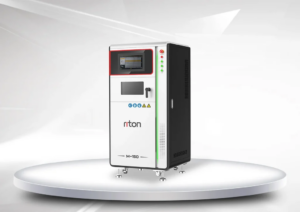
When we need to move beyond standard restorative applications, the M-150 provides a metal SLM platform designed specifically for dental manufacturing. It has single fiber laser with output power up to 500W, scanning speed up to 14,000 mm/s, a melting area of Φ150 × 140 mm including the build plate, and layer thickness of 20–60 μm. It supports CoCr and titanium alloys.
And its production capability of up to 200 metal crowns or 17 frameworks in 4.5 hours, with actual production time varying according to operating conditions. More importantly for broader applications, Riton displays examples including lingual appliances, frameworks, implant-related crown and bridge work, and titanium components.
Why Equipment Stability Matters for Expanding Applications
As we add more applications, equipment stability becomes increasingly important. A printer used for multiple production categories needs to maintain predictable operation across repeated jobs while minimizing unnecessary downtime.
The M-150 uses a hidden sealed structure for moving parts and separates the equipment circuitry from the powder-forming section. This design helps support long-term operational stability and extend equipment lifespan. The system also combines automated gas and oxygen control with dual gas supply functionality to simplify operation.
These features matter from a business perspective because production interruptions can affect delivery schedules, labor allocation, and overall equipment utilization.
Comparing Solutions from Top Metal 3D Printing Companies
When we compare top metal 3D printing companies, we should look beyond laser power and build volume. Application coverage, material compatibility, process stability, software, technical support, and industry experience can have a greater impact on long-term value.
Riton has focused on dental additive manufacturing for years, developing metal printers, resin printers, dental materials, and digital software. The company reports that it launched China’s first metal 3D printer dedicated to dental restoration in 2016 and has subsequently expanded its dental manufacturing ecosystem.
For us, this application-specific experience can be especially valuable when expanding production beyond familiar restoration categories.
Building a Broader Digital Dental Production Workflow
The future of dental additive manufacturing is not simply about printing more crowns and bridges. We can use metal systems for frameworks, lingual appliances, and other customized components, while resin systems can support models, surgical guides, splints, denture-related applications, and additional digital workflows.
Riton’s M-150 gives us a compact metal manufacturing platform with precision-oriented process technologies and a sealed mechanical structure. Combined with Riton’s resin systems and dental materials, it provides a broader foundation for digital production.
For dental businesses planning their next stage of manufacturing, we should therefore evaluate 3D printing based on the applications it can unlock, not only the products it already produces. Expanding beyond crowns and bridges can help us improve equipment utilization, diversify production capabilities, and build a more adaptable digital dental laboratory.