Dental laboratories are moving from conventional manufacturing toward digitally controlled production, and metal additive manufacturing is becoming an important part of that transition. As we evaluate this shift, we see that a laser metal 3D printer can do more than create individual dental components. It can connect digital design, metal powder processing, automated production, and post-processing into a repeatable manufacturing workflow. For laboratories seeking higher efficiency and production flexibility, understanding these applications is essential.
How Does a Laser Metal 3D Printer Work?
A laser metal 3D printer based on selective laser melting (SLM) builds components layer by layer from metal powder. The machine spreads a controlled layer of powder across the build platform, while a computer-controlled laser selectively melts designated areas according to the digital model. The newly formed layer bonds with the previous layer, progressively creating the final geometry.
After printing, the component normally requires post-processing. Depending on the material and application, this can involve removing residual powder and support structures, heat treatment, surface finishing, and other procedures. This digital-to-physical workflow allows dental laboratories to manufacture complex geometries directly from CAD data, reducing dependence on conventional wax patterns and casting steps. Research has demonstrated the potential of SLM for accurate dental frameworks made from materials such as Co-Cr and titanium alloys.
Dental Restorations and Framework Production
One of the most important applications we see is the production of metal dental restorations and frameworks. Our metal 3D printers are designed for dental manufacturing and can process CoCr Alloy and Ti Alloy. And official product portfolio also includes CoCr, Titanium, and NiCr metal powders developed for dental applications. These materials are positioned around properties including strength, corrosion resistance, deformation resistance, and biocompatibility.
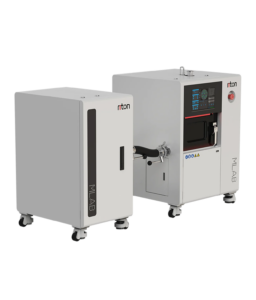
For example, Riton’s MLAB can produce dental crowns and frameworks, with the company reporting a fastest-case productivity of 100 crowns or 7 frameworks in 2.5 hours. Its build area is Φ100 × 90 mm, layer thickness is 20–60 μm, and it uses a single 250W fiber laser with nitrogen or argon protective gas. These specifications make the compact system relevant to laboratories that need dedicated metal production without a large machine footprint.
Supporting High-Volume Dental Production
For laboratories with greater production requirements, we can also consider M-150. This SLM metal 3D printer uses a single fiber laser with output power of up to 500W, a scanning speed of up to 14,000 mm/s, and a melting area of Φ150 × 140 mm including the build plate. Its layer thickness is 20–60 μm, and it supports nitrogen or argon protective gas.
The M-150 is designed for production efficiency as well as precision. The productivity of 200 metal crowns or 17 frameworks in 4.5 hours. The printer also occupies approximately 0.8 m², which allows us to consider metal additive manufacturing even when laboratory floor space is limited.
Titanium and CoCr Applications in Digital Dentistry
Material selection directly influences how we deploy metal additive manufacturing. Riton offers CoCr, Titanium, and NiCr powders for dental applications, while its resources also list TC4 Titanium Alloy Powder. We therefore have options for different digitally manufactured dental applications rather than being restricted to a single metal system.
CoCr alloys are widely used for removable partial denture frameworks, crown and bridge restorations, and implant abutments, offering an optimal balance of strength, wear resistance, and cost-effectiveness. Titanium and its TC4 alloy, by contrast, are preferred for biocompatible applications such as dental implants, surgical plates, and maxillofacial prostheses, where light weight, excellent osseointegration, and corrosion resistance are critical. Matching the right metal to the right indication ensures that restorations not only fit precisely but also perform reliably over the long term within the oral environment.
What Sets Top Metal 3D Printing Companies Apart?
When we compare top metal 3D printing companies, we should look beyond laser power or printing speed. A dental laboratory needs an ecosystem that supports the entire manufacturing chain. Riton’s portfolio includes metal 3D printers, resin 3D printers, metal and resin materials, auxiliary equipment, software platforms, and orthodontic wire-bending equipment.
This broader approach matters because production does not end when the laser stops. For example, Riton’s RT-1300 heat-treatment furnace is designed for its metal 3D printers and operates in a protective atmosphere, with programmable heating curves and intelligent temperature control. Integrating equipment and materials around the printer can help laboratories develop a more consistent digital manufacturing workflow.
Building a More Capable Dental Manufacturing Workflow
For us, the value of laser metal 3D printing lies in how effectively it connects digital design with repeatable physical production. From crowns and frameworks to other complex metal dental components, SLM can give laboratories greater control over customized manufacturing while supporting scalable production.
At Riton, we combine metal additive manufacturing expertise with printers, dental metal materials, auxiliary equipment, software, and digital solutions. As laboratories evaluate the capabilities of leading suppliers, we believe the strongest solution is not simply a laser metal 3D printer, but a complete ecosystem engineered around precision, productivity, materials, and the realities of modern dental production.