Choosing the right metal additive manufacturing technology has become an important decision for dental companies moving toward digital production. As we evaluate different solutions, we often encounter two commonly discussed terms: DMLS machine and SLM machine.
Although both technologies use lasers to produce metal parts layer by layer, their working principles, melting processes, and typical applications have important differences. At Riton, we focus on helping dental businesses understand these differences and select the right metal 3D printing solution for precise and efficient dental manufacturing.
Understanding the Difference Between DMLS Machine and SLM Machine
When we compare a DMLS machine with an SLM machine, the biggest difference comes from how the metal powder is processed during printing. DMLS, or Direct Metal Laser Sintering, uses a laser to heat metal powder particles and bond them together. The process usually creates parts through partial melting and sintering of the powder material.
SLM, or Selective Laser Melting, takes a different approach. The laser completely melts metal powder particles, allowing the material to solidify into a fully dense metal structure. Because of this complete melting process, SLM technology is widely used for applications requiring high strength, accuracy, and reliability.
For dental applications, this difference is especially important. Dental restorations require precise structures, consistent mechanical properties, and reliable repeatability. This is why many modern dental metal printing systems use SLM technology as the foundation for production.
Why Dental Companies Need to Understand Metal Printing Technology
When dental companies invest in digital manufacturing, the printer is not simply a production device. It becomes a key part of the entire workflow, influencing production capacity, restoration quality, and operational efficiency.
Many of the top metal 3D printing companies focus on developing systems that can meet professional manufacturing requirements. However, we should not only compare brands or machine prices. We need to examine the printing technology, material compatibility, software support, and application experience behind each solution.
At Riton, we developed our metal 3D printers based on SLM technology specifically for dental metal restoration production. Our goal is to help dental companies achieve digital transformation with integrated solutions covering equipment, materials, software, and technical support.
SLM Technology: The Advantage of Full Metal Melting
The main advantage of SLM technology is the ability to completely melt metal powder during printing. This process helps create dense metal components with strong mechanical performance and high dimensional accuracy.
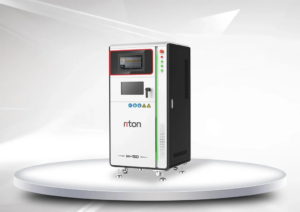
Riton’s M-150 is an SLM metal 3D printer designed for dental applications. The system uses a single fiber laser with an output power of up to 500W and a laser wavelength of 1.064 μm. It provides a scanning speed of up to 14,000 mm/s and a melting area of Φ150 mm × 140 mm, including the build plate.
These specifications allow dental laboratories and companies to produce customized metal restorations with efficient production cycles. The wide build area also provides flexibility for different dental production requirements, from individual restorations to larger batch manufacturing.
Comparing Production Efficiency and Application Requirements
When selecting between a DMLS machine and an SLM machine, we should consider the specific production goals rather than simply focusing on technology names.
DMLS systems have been widely applied in industries such as aerospace, automotive, and general metal manufacturing. They can be suitable for applications where material bonding and functional prototypes are the primary goals.
For dental manufacturing, however, precision and repeatability are critical. Dental companies need equipment that can consistently produce complex structures while maintaining quality standards. SLM technology provides advantages for these requirements because the complete melting process supports high-density metal components.
Riton’s metal 3D printers are designed around these dental production needs. By combining SLM technology with optimized scanning strategies, optical systems, and process control features, we help dental companies establish more reliable digital workflows.
How Riton Supports Digital Dental Manufacturing
Technology selection is only one part of successful digital production. We believe that equipment, materials, software, and service support must work together.
Our metal 3D printing solutions are developed for dental companies looking to improve production efficiency and upgrade their manufacturing capabilities. The M-150 integrates features such as automated gas and oxygen control, a magnetic build plate, and stable mechanical performance to support daily production.
Beyond hardware, we provide an integrated digital ecosystem. This includes compatible dental metal materials, technical training, installation support, and workflow guidance. For businesses adopting additive manufacturing, this integrated approach can reduce implementation challenges and improve long-term production value.
Choosing the Right Metal 3D Printing Solution for Dental Growth
The difference between a DMLS machine and an SLM machine is more than a technical definition. It represents two different approaches to metal additive manufacturing. While both technologies have valuable applications, dental companies should carefully evaluate which process best matches their production requirements.
At Riton, we specialize in SLM-based metal 3D printing solutions for the dental industry. Our M-150 combines precision, efficiency, and stability to support dental companies pursuing digital manufacturing transformation.
As the dental industry continues moving toward customized and digital production, selecting the right technology partner becomes increasingly important. By understanding the differences between printing processes and focusing on complete workflow solutions, we can help dental businesses build more efficient and reliable production systems for the future.