Dental laboratories and clinics are under constant pressure to improve turnaround time, repeatability, and production efficiency without compromising precision. As we evaluate additive manufacturing, we see that the right printer depends less on which technology is newest and more on what we need to produce. LCD 3D printers and metal systems address different workflow requirements, so the decision should begin with applications, materials, volume, and downstream processing.
Where an LCD 3D Printer Fits Best
An LCD 3D printer uses an LCD panel to selectively expose photopolymer resin layer by layer. Because the exposure occurs across an area rather than tracing each feature point by point, the technology can support efficient production of resin dental parts. LCD-based systems are also generally attractive when equipment cost and access to resin-based applications are important considerations. For organizations handling varied case types, resin platforms can make it practical to maintain several validated material profiles for different indications, as long as the printer, resin, software settings, and post-processing workflow are properly matched.
For dental teams, resin printing can support applications such as models, surgical guides, splints, trays, try-ins, denture bases, and other digitally designed components, provided the selected resin is appropriate for the intended use. The American Dental Association also recommends assessing materials, build-platform size, software compatibility, post-processing, and the specific products a practice intends to manufacture before selecting a 3D printer.
This makes an LCD 3D printer a logical choice when our workflow is centered on resin applications and we need flexibility across different digitally designed products. However, the printer itself is only one part of the equation. Material validation, washing, curing, support removal, and process control can all affect the final workflow.
When Metal 3D Printing Makes More Sense
Metal additive manufacturing becomes more relevant when our production requirements center on durable metal dental restorations and frameworks. Rather than choosing a printer simply by headline resolution or speed, we should consider the complete production chain, including powder, atmosphere control, build capacity, post-processing, and repeatability. These factors matter especially for business dental operations, where predictable production and equipment utilization directly influence scheduling, labor allocation, quality control, and the ability to handle recurring order volumes.
Riton has focused on dental metal additive manufacturing for decades and pioneered the application of metal 3D printing in China’s dental sector. Our current portfolio combines metal and resin 3D printers with materials, auxiliary equipment, software, and other digital dental solutions. This integrated approach helps us address the workflow rather than treating the printer as an isolated machine.
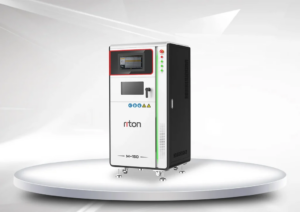
The Riton M-150 illustrates this approach. It uses a single fiber laser with output power of up to 500W, a 1.064 μm wavelength, and a scanning speed of up to 14,000 mm/s. Its melting area is Φ150 × 140 mm including the build plate, while layer thickness is 20–60 μm. The system supports nitrogen or argon protective gas and can print 200 metal crowns or 17 frameworks in 4.5 hours.
The M-150 is also designed for space-conscious production environments. Its footprint is about 0.8 m², while the machine dimensions are 780 × 950 × 1,660 mm and weight is 500 kg. It supports CoCr alloy and titanium alloy, giving dental production teams options for different metal manufacturing requirements.
Choosing by Workflow, Not Printer Category
For us, the most useful question is not whether an LCD 3D printer or metal printer is inherently better. It is which technology aligns with the products, materials, throughput, and post-processing resources already established in the laboratory or clinic.
An LCD system can be a strong fit when resin-based applications represent the core workload. Metal printing is more compelling when the business needs to produce metal crowns, bridges, frameworks, or other restoration-related components at production scale. A mixed environment may also make sense when resin and metal technologies serve complementary stages of the digital workflow.
When comparing leading 3D printer manufacturers, we recommend looking beyond individual machine specifications. Consider whether the supplier can support materials, auxiliary equipment, software, training, service, and workflow integration. This broader evaluation can reveal whether a printer will improve the entire production system rather than simply add another piece of equipment.
Building a Dental Production Strategy That Scales
Our view is straightforward: choose the technology according to the work you need to complete repeatedly and profitably. An LCD 3D printer can provide an efficient route for resin-based dental production, while a metal system can better match workflows built around durable metal restorations and frameworks.
At Riton, we don’t just build dental 3D printers—we architect complete production ecosystems across metal and resin technologies, seamlessly integrating materials, software, auxiliary equipment, and digital workflow services.
For laboratories and clinics charting their next growth phase, we believe the smartest investment isn’t a machine on a bench. It’s a future-ready workflow—one engineered for uncompromising precision, relentless efficiency, and production capacity that scales with your success.