Choosing between an LCD 3D printer and a metal 3D printer is less about which technology is inherently better but more about which one matches a dental laboratory’s production model. We see both technologies serving different roles across digital dentistry. LCD systems can efficiently produce resin models and other dental applications, while metal additive manufacturing addresses durable, patient-specific components. At Riton, we help businesses evaluate these technologies according to application, material, throughput, and available production space.
LCD 3D Printer: Efficient for Resin-Based Dental Production
An LCD 3D printer uses light to cure photosensitive resin layer by layer. For dental laboratories, this approach is well suited to applications such as models, orthodontic thermoforming models, surgical guides, splints, denture bases, and other resin-based products, depending on the material and printer configuration.
Our Model S1.0, for example, is designed for dental models and is suitable for orthodontic thermoforming models and other common dental applications. It is compatible with LCD/DLP equipment and uses a 385–405 nm wavelength range. The material is also designed for mass production, making this type of resin workflow relevant to laboratories handling repeated model orders.
For businesses producing a high volume of resin-based dental models, an LCD workflow can therefore provide a practical balance of production efficiency, material flexibility, and application coverage. We believe the key is to match the printer and resin to the intended clinical or laboratory use rather than selecting equipment based only on resolution or advertised speed.
When Metal 3D Printing Becomes the Better Fit
Metal additive manufacturing becomes more relevant when the workflow requires metal components and the associated mechanical properties of dental alloys. Our metal materials portfolio includes CoCr, titanium, and NiCr powders developed for SLM dental applications. These materials are intended for dental restoration and are positioned around characteristics including high strength, corrosion resistance, and biocompatibility.
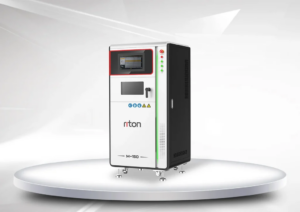
Our M-150 is designed specifically around dental metal production. It uses a single fiber laser with output power of up to 500W, a melting area of Φ150 × 140 mm including the build plate, and a layer thickness range of 20–60 μm. It supports nitrogen or argon protective gas and CoCr or titanium alloys.
The M-150 is also designed to handle production constraints that matter to commercial laboratories. Its overall dimensions are 780 × 950 × 1660 mm, and Riton states that it occupies about 0.8 m². That compact footprint can help laboratories adapt production equipment to limited floor space while adding metal additive manufacturing capabilities.
Space and Throughput Can Change the Decision
When we evaluate equipment with business customers, we look beyond the printing principle. Available floor space, expected production volume, material consumption, post-processing requirements, and workflow integration all affect the total value of an investment.
The M-150 offers a stated productivity of 200 metal crowns or 17 frameworks in 4.5 hours. It also incorporates automated deoxidation logic and a dual gas supply system, which can reduce gas consumption and waiting time for equipment to refill with gas. These features can be relevant when a dental laboratory is planning repeated production rather than occasional prototyping.
An LCD 3D printer may be the more practical choice when the core workload is resin models or other photopolymer applications. A metal system becomes more appropriate when the laboratory needs to manufacture metal crowns, bridges, frameworks, or similar components. In some operations, the practical may be to use both technologies as complementary stages of one digital workflow.
How Leading 3D Printer Manufacturers Support Workflow Decisions
We believe leading 3D printer manufacturers should help customers choose an appropriate production architecture rather than simply promote individual machines. For dental businesses, this means considering printers, materials, software, post-processing, training, and technical support as connected parts of the investment.
Riton’s portfolio spans metal and resin 3D printers, dental metal and resin materials, automatic wire bending machines, and digital platforms. Our approach is designed to help dental laboratories build end-to-end workflows rather than isolate printing from the rest of production. This is particularly valuable when a business expects its digital manufacturing needs to expand over time.
Choosing the Right Technology for Your Business
We recommend starting with the products your laboratory needs to manufacture most frequently. If your workload centers on dental models, orthodontic thermoforming models, surgical guides, splints, or other resin applications, an LCD 3D printer can be a logical production foundation. If your priority is metal dental restoration and framework production, metal SLM technology is more appropriate.
Building a Scalable Digital Dental Workflow
We do not consider LCD and metal 3D printing competing technologies in every dental application. They solve different manufacturing requirements, and the strongest workflow can use each where it provides the greatest value. Resin printing can support model and appliance production, while metal printing can address durable metal dental components.
At Riton, we combine both technologies with application-specific materials and supporting digital solutions. For businesses evaluating their next equipment investment, we recommend choosing according to actual production needs, future capacity, available space, and workflow integration. That approach can make the technology decision more practical—and create a stronger foundation for scalable digital dentistry.