Dental laboratories need equipment that balances production capability with practical constraints. Large industrial metal systems can offer high throughput, but their footprint and infrastructure requirements may not suit every laboratory. We believe a desktop 3D metal printer can provide a more accessible route to metal additive manufacturing when its laser system, process control, materials, and workflow are designed specifically for dentistry.
Compact Does Not Mean Underpowered
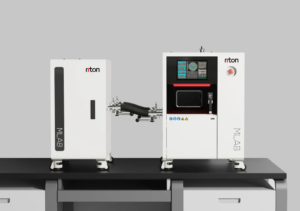
For us, the first question is not whether a printer is physically small, but whether its architecture can deliver dependable production performance. Riton’s MLAB was developed as a desktop metal 3D printer for digital dentistry, combining a compact footprint with features intended to support efficient and stable metal printing.
MLAB occupies approximately 0.36 m², and Riton states that its footprint is 69% smaller than conventional printers. The machine measures 610 × 615 × 890 mm and weighs 150 kg. Its melting area is Φ100 × 90 mm, including the build plate, providing practical build space for dental applications while addressing laboratories where floor space is limited.
Laser Performance Still Matters
A compact housing would have little value if the printing system could not meet production requirements. We therefore evaluate the laser, scanning speed, layer thickness, and material compatibility when assessing whether a desktop system is suitable for professional dental work.
MLAB uses a 250W single fiber laser, with a maximum scanning speed of 11,200 mm/s and a 20–60 μm layer thickness range. CoCr alloy and titanium alloy as compatible melting materials. In the fastest case, MLAB can print 100 crowns or seven frameworks in 2.5 hours, although actual production time depends on operating conditions.
Stability Supports Consistent Dental Production
Dental laboratories need repeatability because restorations and frameworks are produced from patient-specific digital designs. Stable machine operation therefore becomes as important as headline speed. We consider control architecture and cooling systems important when evaluating the suitability of compact metal printers.
MLAB is equipped with both PLC and IPC systems and paired with a six-fan air-cooled laser. Riton states that this configuration significantly improves printing stability. The machine also uses nitrogen or argon as protective gas, while powder quantity monitoring and optimized powder-spreading distance are designed to support printing efficiency and precision.
Space Efficiency Can Improve Laboratory Planning
Floor space has a direct effect on how a laboratory organizes production equipment, operators, material handling, and post-processing. A smaller machine can make it easier for businesses to integrate metal printing without redesigning an entire production area.
The MLAB’s approximately 0.36 m² footprint is particularly relevant for dental laboratories that want to bring metal printing in-house but face space limitations. We designed the system around a desktop form factor rather than simply reducing dimensions. Remote transmission of printing data and an upward powder-feeding structure also support a streamlined operating workflow.
Software Completes the Printing System
Hardware alone does not determine whether a compact printer is practical for daily production. Operators need clear process information and tools that help them respond to interruptions or identify problems quickly. That is why we treat software as part of the production system rather than an optional accessory.
MLAB uses Riton Controller, which provides real-time equipment-operation and printing-status feedback. The software records printing progress, logs layer status, filters key information, and recognizes a pause point so printing can resume after certain interruptions. These functions can help laboratories improve process visibility and production continuity.
What Leading 3D Printer Manufacturers Should Offer
When comparing leading 3D printer manufacturers, dental businesses should examine more than machine size and laser power. The supplier’s application experience, compatible materials, software, training, technical support, and broader equipment portfolio can influence the long-term value of an investment.
Riton has focused on laser technology and dentistry since its establishment in 1997. We launched China’s first metal 3D printer dedicated to dental restoration in 2016 and introduced the MLAB desktop metal 3D printer in 2024. Today, our digital dental ecosystem includes metal and resin 3D printers, dental materials, software platforms, and related equipment.
Making Desktop Metal Printing a Practical Investment
A desktop 3D metal printer can be powerful enough for dental labs when compactness is combined with appropriate build volume, laser configuration, material compatibility, process stability, and production software. We do not view small dimensions as a substitute for performance; we see them as valuable when engineering makes efficient use of limited space.
MLAB demonstrates this approach with its 250W fiber laser, 20–60 μm layer thickness, 11,200 mm/s maximum scanning speed, and compatibility with CoCr and titanium alloys. Its compact footprint, PLC and IPC controls, six-fan air-cooled laser, and Riton Controller further support professional dental production requirements.
A Compact Route to Digital Dental Manufacturing
For dental laboratories considering metal additive manufacturing, the right question is not simply whether a desktop machine is smaller than an industrial printer. The more useful question is whether it provides the performance, stability, workflow integration, and material options needed for actual production goals.
We developed MLAB to make professional metal 3D printing more accessible to space-conscious dental businesses without abandoning the requirements of precision and efficiency. As laboratories continue their digital transformation, we believe a well-engineered desktop 3D metal printer can become a practical production asset rather than merely an entry-level machine.