Digital dentistry is moving beyond isolated equipment purchases toward connected production ecosystems. For dental laboratories, clinics, and orthodontic providers, selecting among leading 3D printer manufacturers therefore requires more than comparing resolution, build volume, or machine price.
You need to evaluate the complete workflow: materials, software, production capacity, regulatory quality, training, and after-sales support. The right partner can help you build a reliable digital manufacturing process that can scale with changing clinical and laboratory requirements.
How to Evaluate Leading 3D Printer Manufacturers
When you assess a dental 3D printer manufacturer, first look at whether its technology matches our actual applications. Resin systems can support dental models, surgical guides, gingiva masks, splints, try-ins, denture bases, trays, temporary models, crowns, and other workflows. Metal systems can serve restoration applications using materials such as CoCr, titanium, and NiCr.
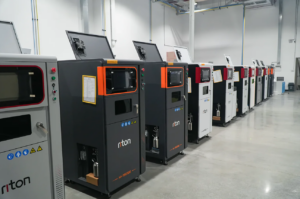
Also you should consider the production environment. A compact printer may be appropriate for a laboratory with limited floor space, while a larger or higher-throughput system may better suit centralized production. For example, our M-150 features a Φ150 × 140 mm melting area, supports 20–60 μm layer thickness, and, according to its published specifications, can print 200 metal crowns or 17 frameworks in 4.5 hours, enhanced by added features such as segmented variable speed, dual-cylinder lifting, and pre-powder spreading. These details are more useful for capacity planning than headline claims about speed or precision.
Material Compatibility Should Match the Workflow
A capable printer is a part of the production equation. You need materials that are developed for the intended dental application and supported by a controlled workflow. The FDA notes that consistent material specifications are important for producing consistent, high-quality 3D-printed medical devices, while material performance must be considered according to intended use.
This makes material compatibility an important criterion when comparing leading 3D printer manufacturers. Our ecosystem includes CoCr, titanium, and NiCr metal powders, alongside dental resin materials for applications such as models, surgical guides, gingiva masks, casting wax, splints, try-ins, denture bases, trays, crowns, and denture teeth. This breadth can simplify procurement and workflow standardization for dental businesses.
Evaluate the Integrated Digital Ecosystem
Besides, you should examine what happens before and after the print. Digital dentistry involves design, software preparation, material controls, printing, and post-processing. A manufacturer that connects these stages can reduce integration complexity and make production easier to manage. The FDA likewise describes software workflow and material controls as important parts of the additive manufacturing process.
We combine metal and resin 3D printers with automatic orthodontic wire bending equipment and proprietary software platforms. Our WBM-V2, for example, supports wire diameters from 0.5–1.0 mm, feeding accuracy of ±0.05 mm, and bending repeatability of ±0.5°. It connects with Riton Cloud & OrthoWireLab for design-to-production coordination, illustrating how equipment can become part of a broader digital workflow rather than operating as a standalone machine.
Quality, Compliance, and Technical Support Matter
For dental businesses, equipment reliability must be considered alongside quality management and regulatory readiness. ISO 13485:2016 establishes requirements for quality management systems specifically for medical devices and emphasizes processes that support safety, regulatory requirements, and consistent production. Therefor, you need to examine a supplier’s certifications, manufacturing controls, material documentation, and product support before making a long-term investment.
At Riton, we have obtained ISO 13485 and EU CE certifications, according to our company history. You should still verify the specific certification, registration, or authorization applicable to each product and target market rather than treating company-level credentials as interchangeable.
Support is equally important. Training, technical guidance, troubleshooting, maintenance resources, and software updates can directly affect equipment utilization. We provide professional operation training and maintain resources covering printers, materials, software, and workflow guidance. For laboratories expanding digital production, this support can shorten the learning curve and reduce avoidable downtime.
Build a Partnership for Long-Term Growth
The best dental 3D printer manufacturer should fit both today’s production requirements and tomorrow’s expansion plans. You need to consider whether the supplier can support multiple applications, new materials, additional equipment, workflow automation, and international requirements as our business grows.
Our history provides a useful example of this broader approach. We were founded in 1997 and developed China’s first metal 3D printer dedicated to dental restoration in 2016. Since then, we have expanded into resin printing, orthodontic wire bending, dental materials, and digital platforms. Our website reports over 2,000 dental laboratory collaborations and more than 5000 Riton metal 3D printers in installation worldwide as of 2024.
Turning Equipment Selection into a Strategic Decision
Choosing among leading 3D printer manufacturers is ultimately a workflow decision, not simply a machine comparison. For you, evaluating application fit, material compatibility, production capacity, software integration, quality systems, technical support, and future scalability together.
As a dental 3D printer manufacturer focused on end-to-end digital dentistry, we at Riton provide metal and resin printing technologies, clinical-grade materials, orthodontic wire bending, software, and training services. We invite dental laboratories and clinics seeking a scalable digital production partner to explore our solutions and discuss a workflow designed around their specific requirements.