Dental labs are under increasing pressure to produce accurate metal restorations efficiently while controlling equipment, labor, and production costs. For labs considering an in-house digital workflow, selecting among the leading 3D printer manufacturers requires more than comparing laser power or build volume.
You need to evaluate productivity, material compatibility, footprint, process stability, powder handling, software, and the practical demands of dental production.
What Should Dental Labs Look for in Metal 3D Printers?
When evaluating metal 3D printing equipment for a dental laboratory, buyers should start with the applications the machine needed to support. Dental production can involve crowns, frameworks, and other customized components, so a printer needs to combine repeatable processing with a workflow suitable for frequent small-batch production.
Material compatibility is equally important. We should confirm whether a printer supports the alloys required for applications and whether the manufacturer provides appropriate material and process support. Riton’s dental metal material portfolio includes CoCr, Titanium, and NiCr powders developed specifically for SLM technology in dental applications.
Also you need to consider the complete production environment rather than the printer alone. Powder handling, inert gas requirements, software, post-processing, and operator training can all influence the real cost and productivity of an installation.
How Leading 3D Printer Manufacturers Compare on Workflow Efficiency
For dental labs, productivity should be measured in relation to actual workloads rather than headline specifications. A compact machine may be more practical for a laboratory producing moderate volumes, while larger platforms can make sense when production demand requires higher throughput.
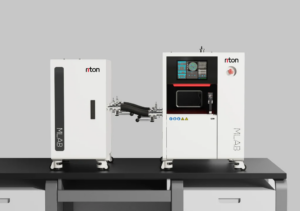
Therefore, you need to compare build volume, layer thickness, scanning speed, material options, and production examples together. Riton’s MLAB, for example, uses a single 250W fiber laser, offers a maximum scanning speed of 11,200 mm/s, and supports layer thicknesses from 20–60 μm. Its melting area is Φ100 × 90 mm, including the build plate.
For dental production, Riton states that MLAB can print up to 100 crowns or seven frameworks in 2.5 hours in the fastest case, although actual production time varies according to operating conditions. This makes application-specific productivity a more meaningful benchmark than simply comparing machine size.
Why Footprint and Production Stability Matter
Space is an important procurement consideration for dental laboratories, particularly when adding metal printing without expanding the facility. Equipment that occupies less floor space can simplify workflow planning and leave room for post-processing and other digital production equipment.
Riton positions MLAB as a desktop-sized metal 3D printer occupying approximately 0.36 m², with a footprint reduced by 69% compared with the conventional printers referenced by the company. The machine measures 610 × 615 × 890 mm and weighs 150 kg.
Stability also deserves close attention. MLAB incorporates PLC and IPC systems and a six-fan air-cooled laser, while its powder-spreading system monitors powder quantity and optimizes spreading distance. These features are designed to support consistent and efficient printing.
Powder Handling, Gas Supply, and Operator Safety
Metal additive manufacturing requires you to consider operational safety and supporting infrastructure during equipment selection. MLAB uses nitrogen or argon as protective gas and features a pre-soaked circulation-system design intended to help prevent explosions when cleaning the filter.
We also offer the RXT-10L nitrogen generator as auxiliary equipment for MLAB. The unit provides adjustable nitrogen purity up to 99.9% and has a rated nitrogen output of 0.6 Nm³/h, helping laboratories establish a more integrated gas-supply setup.
These details matter during procurement because the printer, gas supply, powder management, workspace, and safety procedures should be assessed as one production system.
Software and Total Workflow Support
Hardware performance alone does not determine the efficiency of a digital dental workflow. You should also examine whether the manufacturer provides software that makes machine monitoring and production management straightforward.
Riton’s MLAB uses Riton Controller, which provides real-time equipment and printing-status monitoring, printing-content editing, key-information filtering, and intelligent print-resume functions. Such capabilities can help operators identify equipment status and manage production more efficiently.
Considering the supplier’s broader technical ecosystem is also important. Riton provides metal and resin 3D printers, dental materials, software platforms, and other digital dental equipment.
Why Riton MLAB Deserves Consideration in 2026
For dental laboratories seeking a compact metal additive manufacturing solution, we see MLAB as a practical option when space efficiency, dental-oriented production, and workflow integration are priorities. Its support for CoCr and titanium alloys, compact 610 × 615 × 890 mm dimensions, 20–60 μm layer thickness, and dental-focused production capability provide a clear basis for evaluation.
Ultimately, choosing among the best metal 3D printers should depend on actual production requirements rather than a generic ranking. You should compare applications, throughput, materials, infrastructure, software, safety, service, and long-term workflow support before investing.
Making a More Informed Dental 3D Printing Investment
Evaluating metal additive manufacturing for dental laboratories in 2026, you should look beyond individual machine specifications and assess the entire production ecosystem. Riton combines dental metal printing equipment with compatible materials, software, and supporting solutions, giving laboratories a broader foundation for building digital workflows.
For labs seeking a compact, dental-focused metal printing platform, we provide our MLAB as a strong option to investigate. If you need, you can contact us to discuss application requirements, material compatibility, production targets, and the appropriate configuration for our laboratory.