The collaborative paper “High toughness of 3D printed ceramic/polymer interpenetrating phase composite with gradient structures under multi-directional stresses” by Guangzhou Riton Biomaterial Co., Ltd., Guangdong Provincial Key Laboratory of Nanophotonic Functional Materials and Devices, School of Optoelectronic Science and Engineering, South China Normal University and Department of Mechanical and Energy Engineering, Southern University of Science and Technology was successfully published in the authoritative academic journal Journal of Materials Science in the field of materials science.
The paper points out that zirconia possesses high strength and good biocompatibility, but the inherent brittleness limits its further application. Inspired by the biomimetic structures, the interpenetrating phases have been demonstrated a toughening effect on zirconia ceramic. In practical application, materials are subjected to stresses in different directions, which makes the toughening of materials more complex.
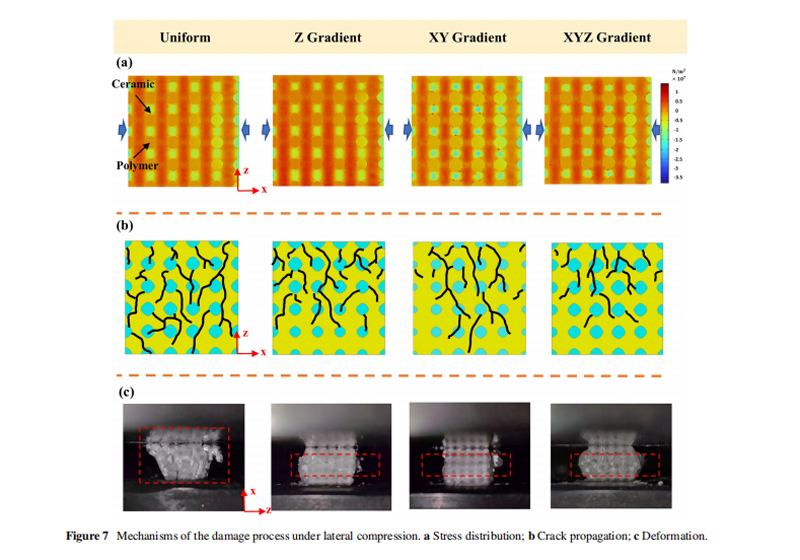
This study mentions a method of fabricating ceramic/polymer composite by 3D printing, and proposes three gradient structures with varying porosity in Z/XY/XYZ different directions for toughening. Composite infiltrated with hard-tough polymer prevents catastrophic failure and shows an increase of 400% in toughness. Under different directions of stresses, composites with gradient structures all display an enhancement in toughness compared with the uniform structure. The gradient changes in Z/XY/XYZ are able to achieve high toughness under multi-directional stresses, meeting the requirements of practical applications in different fields.
Zirconia material is one of the important materials in the biomedical field. The collaborative research by Riton, South China Normal University and Southern University of Science and Technology has opened up a new path for the application of zirconia materials in biomedical science and other high-demand fields, and provided a feasible solution to the brittleness problem of traditional ceramic materials.
In the future, Riton will continue to maintain its professionalism, focus on technological innovation and product optimization, specialize in equipment and material research, and strive to transform theoretical results into actual productivity, and contribute its own strength to promoting the progress and development of the additive manufacturing field!
Journal information
Journal of Materials Science (J Mater Sci) was founded in 1966 and has long been committed to promoting the interdisciplinary development of materials science, covering metals, ceramics, glass, polymers, electrical materials, composite materials, fibers, nanostructured materials, nanocomposites, biological and biomedical materials fields and so on. This journal is in Zone 3 of the Chinese Academy of Sciences and in Q2 of the JCR.