Dental laboratories are moving beyond basic digitization toward integrated, production-oriented additive manufacturing. We believe the top 3D metal printing companies distinguish themselves by combining printing performance, process stability, intelligent software, material compatibility, operational efficiency, and industry-specific experience. For us, these factors provide a more meaningful basis for evaluating a technology partner than any single machine specification.
Engineering That Balances Build Volume and Footprint
Production capacity is one of the first factors we consider when assessing a metal additive manufacturing system. A larger build area can support more components per cycle, but increasing machine size can also create practical challenges for dental laboratories where floor space is valuable.
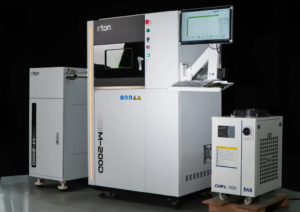
Our M-200D addresses this balance with a 150 × 220 mm melting area and a 140 mm build height, representing a 40% increase in build height. Its dimensions are 1,000 × 750× 1,650 mm. This gives production teams more usable build capacity without simply expanding the machine’s physical presence.
Dual-Laser Performance for Higher Throughput
For production-oriented dental laboratories, printing speed must be considered together with batch capacity and process consistency. The M-200D uses double fiber lasers, with each laser offering an output power of up to 500 W. The system has a maximum melting speed of 14,000 mm/s and supports layer thicknesses from 20–60 μm.
These specifications are relevant because dental production frequently involves multiple crowns or partial frameworks within the same manufacturing cycle. Riton specifies production of up to 430 crowns or 35 partial frames in 5.5 hours. Actual results vary with build arrangement, material, parameters, and operating conditions.
Cleaner Builds Through Controlled Airflow
Printing quality depends on more than laser power. The atmosphere around the melt pool must also be controlled to support stable processing. We therefore consider gas management and airflow design important differentiators when comparing leading 3D printer manufacturers.
The M-200D uses nitrogen or argon as protective gas and is designed with uniform airflow for cleaner builds. We also identify a permanent filter with back-blowing as a feature intended to reduce production costs. This approach connects the printing environment with ongoing equipment operation and maintenance.
Smart Software Is Part of the Production System
A metal printer becomes more valuable when operators can understand and manage the process efficiently. For us, smart control is not simply a convenience feature; it can support production visibility and faster response when issues arise.
Riton’s M-200D includes smart control software with live monitoring and flaw detection. Riton Controller also provides real-time monitoring of equipment operation and printing status, intuitive displays of component states and printing information, and rapid fault diagnosis. These capabilities help teams maintain closer oversight of production.
Materials and Application Expertise Matter
Hardware specifications alone do not determine whether a metal printing solution fits a dental laboratory. We also examine supported materials, process requirements, application knowledge, and the supplier’s ability to build an ecosystem around the printer.
The M-200D supports CoCr and titanium, with a glove box and explosion-proof circulation specified for titanium printing. Riton’s broader dental portfolio includes metal and resin 3D printers, automatic wire bending machines, clinical-grade materials, and proprietary cloud design platforms. We developed this integrated approach around dental workflows rather than treating additive manufacturing as a standalone process.
What Leading 3D Printer Manufacturers Should Deliver
When comparing leading 3D printer manufacturers, we believe buyers should evaluate the full lifecycle of the equipment. The questions extend beyond “How fast can it print?” They include: How much can each build cycle produce? How is the printing environment controlled? How easy is process monitoring? What materials are supported? How will the supplier help with training, maintenance, and workflow development?
Our experience in dental additive manufacturing informs this broader perspective. Riton was established in 1997 and later pioneered the application of metal 3D printing in China’s dental sector. We have continued expanding our digital dental ecosystem, with equipment, materials, software, and services designed to help laboratories improve efficiency and precision.
Why Top 3D Metal Printing Companies Focus on the Whole Workflow
The strongest suppliers do not compete on one specification alone. They connect machine architecture, build capacity, environmental control, software, materials, and technical support into a coherent manufacturing solution. For dental laboratories, that integration can matter more than a single headline number.
We designed the M-200D around this principle. Its dual-laser architecture, larger build volume, reduced footprint, uniform airflow, permanent filter with back-blowing, and smart control capabilities address several production priorities at once. As dental manufacturing becomes more digital and batch-oriented, we believe this systems-level approach will increasingly define the top 3D metal printing companies.
Building a More Capable Dental Production Future
Choosing a metal 3D printing partner is ultimately a decision about production capability, not just equipment acquisition. We at Riton continue to combine laser engineering experience with dental application expertise to develop solutions for modern laboratories. With the M-200D, we aim to give production teams a practical balance of capacity, quality, cleaner operation, and intelligent control. For laboratories planning their next stage of digital manufacturing, that balance is worth evaluating carefully.