Orthodontic treatment is becoming increasingly digital, and we see 3D printing as a key technology behind that shift. For dental laboratories and clinics, the value extends beyond producing physical parts: digital manufacturing can connect patient data, design, materials, production, and quality control in a more streamlined workflow. As Riton, we focus on building these connected capabilities so dental professionals can move from conventional production toward scalable, data-driven orthodontic manufacturing.
From Digital Data to Customized Production
Traditional orthodontic workflows often involve multiple manual steps between diagnosis, design, and appliance fabrication. 3D printing in orthodontics helps shorten that chain by converting digital designs into physical products with additive manufacturing.
This approach supports personalized production while reducing the dependence on conventional tooling and repetitive fabrication. It also gives production teams a clearer path toward standardized digital workflows, where case information can move from design to manufacturing with fewer manual conversions. For businesses handling growing order volumes, that consistency can be as important as the ability to produce a highly customized appliance.
We see particular value in digital workflows when laboratories manage diverse cases. Digital files can be prepared, modified, stored, and reproduced more efficiently than relying solely on physical models. Riton’s broader ecosystem combines metal and resin 3D printers, materials, wire-bending equipment, and cloud-based design tools, allowing businesses to connect more stages of production within one digital environment.
Why Metal 3D Printing Matters for Orthodontic Manufacturing
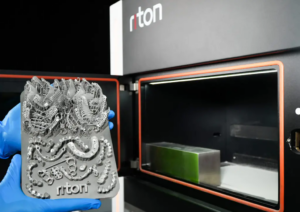
Metal additive manufacturing is especially relevant when orthodontic businesses need durable, customized components. Riton’s metal 3D printing portfolio supports dental applications using materials such as CoCr and titanium. Our M-200D uses double fiber lasers, with each laser offering output power of up to 500W. Its melting area measures 150 × 220 mm, while the melting thickness range is 20–60 μm.
The M-200D also provides a 140 mm build height, representing a 40% increase. For production teams, greater build capacity can provide more flexibility when arranging jobs and planning batches. Rather than evaluating a printer only by its headline speed, we believe laboratories should consider how build capacity affects actual production utilization and workflow efficiency.
How Leading 3D Printer Manufacturers Are Advancing Digital Dentistry
As leading 3D printer manufacturers continue developing dental-specific systems, software is becoming as important as hardware. We designed the M-200D around smarter production management, including live monitoring and flaw detection. Riton Controller further supports real-time equipment and print-status monitoring, rapid fault diagnosis, printing logs, and intelligent resume functions after unexpected interruptions.
This level of visibility matters in a professional dental environment. Production managers need to understand what is happening during a print rather than discovering problems only after a build has finished. Digital monitoring can help teams identify issues earlier, improve process traceability, and make production decisions based on recorded information instead of assumptions.
A More Integrated Orthodontic Workflow
The transformation does not stop at the printer. We connect equipment with digital platforms to create a more complete workflow. Riton Cloud and OrthoWireLab provide functions such as AI-assisted archwire design, archwire occlusion interference analysis, model editing, cloud data storage, and order entry by scanning. These capabilities help connect digital design with manufacturing and communication between doctors and technicians.
For orthodontic businesses, integration can also support operational scalability. When design information, production data, and equipment are connected, teams can reduce unnecessary handoffs and improve visibility across orders. We see this as an important distinction between simply owning a 3D printer and building a genuinely digital orthodontic production system.
What This Means for Dental Labs and Clinics
For dental laboratories, the business case for digital manufacturing is closely tied to repeatability, production efficiency, customization, and workflow control. 3D printing can help teams produce patient-specific dental products without depending on the same degree of manual fabrication for every case. It can also make digital files easier to archive and reproduce when appropriate.
Clinics benefit from the same digital foundation through closer collaboration with laboratories and technicians. When treatment-related designs can move through a connected digital workflow, communication becomes easier to manage. We believe this is particularly important as orthodontic businesses seek to handle more customized cases without allowing operational complexity to grow at the same pace.
Our View of the Next Orthodontic Production Model
We believe 3D printing in orthodontics is reshaping treatment not through one isolated machine, but through a connected manufacturing ecosystem. Digital design, metal and resin printing, automated wire bending, materials, monitoring software, and cloud platforms can work together to create a more efficient production model.
At Riton, we continue developing this ecosystem around the practical needs of dental laboratories and clinics. Our M-200D combines a larger 140 mm build height with dual-fiber-laser technology and smarter monitoring capabilities, while our wider digital solutions connect production with design and workflow management. For businesses preparing for the next stage of orthodontic manufacturing, this integrated approach can provide a stronger foundation for precision, scalability, and productivity.