Finding a reliable 3D metal printer for sale is not simply a matter of comparing machine prices. For dental laboratories and clinics, the right equipment must fit production requirements, available space, material needs, workflow, and long-term service expectations.
We believe buyers should evaluate the complete manufacturing solution rather than a single machine specification. At Riton, we develop dental additive manufacturing systems around practical production requirements, combining metal 3D printing equipment, materials, and digital solutions.
Start With the Application, Not the Machine Price
Before choosing a metal printer, we recommend defining exactly what the equipment needs to produce. Dental laboratories may require different capabilities for crowns, bridges, partial frameworks, and other restorations. Production volume, material compatibility, build capacity, and expected turnaround time should therefore guide the purchasing decision.
Riton focuses specifically on dental applications. Our portfolio includes metal 3D printers such as MLAB, the M-150 series, and M-200D, alongside resin 3D printers, metal and resin materials, automatic wire bending equipment, and digital solutions. This application-focused approach helps us understand the requirements of dental production instead of treating metal additive manufacturing as a one-size-fits-all process.
What to Look for in a 3D Metal Printer for Sale
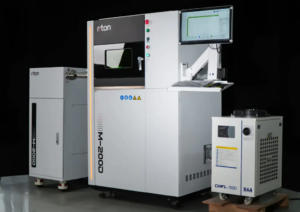
A reliable system should offer measurable specifications that correspond with actual production requirements. For example, our M-200D uses double fiber lasers, with a maximum output power of 500W per laser. Its melting area is 150 × 220 mm, with a melting thickness range of 20–60 μm. The system supports nitrogen or argon as protective gas and is designed for CoCr and titanium applications.
Build volume is another important consideration. The M-200D provides a 140 mm build height, which Riton identifies as a 40% increase. For laboratories processing multiple dental components, additional build height can provide greater flexibility when arranging production jobs and planning batches. We consider usable build capacity more meaningful than simply comparing machine dimensions on a sales sheet.
Why Software and Production Environment Matter
Hardware specifications alone do not determine the overall value of a metal 3D printer. We also focus on the production environment surrounding the printing process. The M-200D incorporates a permanent filter with back-blowing and a design intended to provide a cleaner printing environment. Its airflow design supports more uniform conditions during printing, helping us pursue consistent production quality.
Smart control is equally important for professional operations. The M-200D provides live monitoring and flaw detection, giving production teams greater visibility into the printing process. Its technical parameters include a maximum melting speed of 14,000 mm/s, while the machine also records a stated production capability of 430 crowns or 35 partial frames in 5.5 hours under Riton’s specified conditions.
How Top Metal 3D Printing Companies Support Business Buyers
When comparing top metal 3D printing companies, we recommend looking beyond the initial equipment quotation. A dependable supplier should be able to demonstrate relevant application experience, material compatibility, technical support, and a product ecosystem capable of supporting production as requirements evolve.
Riton has positioned its technology around digital dentistry and states that it pioneered the application of metal 3D printing in China’s dental sector. Our current ecosystem connects metal and resin printers with dental materials, automatic wire bending machines, and proprietary digital platforms. Riton’s metal material portfolio includes CoCr, titanium, and NiCr products developed specifically for dental SLM applications.
Where Should Businesses Buy Their Equipment?
For business buyers, the most reliable starting point is usually the manufacturer’s official product channel. This makes it easier to verify specifications, application suitability, available materials, documentation, and technical support before making an investment.
We encourage prospective customers to request detailed information rather than relying solely on marketplace listings or generic equipment descriptions. For the M-200D, buyers can review its official technical parameters and contact us directly for product pricing and further requirements. This approach creates a clearer connection between the equipment being evaluated and the production application it must ultimately support.
Building a More Reliable Dental Manufacturing Future
Choosing a 3D metal printer for sale should ultimately be a production decision, not simply a purchasing decision. We believe the strongest choice combines appropriate build capacity, verified material compatibility, intelligent monitoring, a controlled printing environment, and dependable technical support.
At Riton, we continue to develop our dental additive manufacturing ecosystem around these priorities. The M-200D combines dual-fiber-laser efficiency, a 140 mm build height, smarter software, and a cleaner production environment, while our wider portfolio connects metal printing with materials and digital dental workflows. For laboratories planning their next investment, evaluating the complete ecosystem can provide a stronger foundation for efficient and scalable production.