Dental production demands more than the ability to melt metal. We need equipment that can consistently process dental alloys, maintain dimensional accuracy, manage the printing environment, and support efficient digital workflows.
For us, a laser metal 3D printer becomes suitable for dental applications when its laser system, build architecture, materials, software, and process controls work together around real laboratory requirements.
Laser Technology Designed for Dental Metal Production
We use Selective Laser Melting (SLM) technology in our metal 3D printers. The process selectively melts metal powder layer by layer with a high-energy laser, allowing dental laboratories to manufacture customized metal components directly from digital designs. This makes the technology suitable for digitally driven production of restorations and frameworks.
For dental businesses, the importance of this technology extends beyond simply replacing conventional fabrication. Digital production can connect scanning, CAD design, printing, and subsequent processing into a more standardized workflow. We developed our metal printing equipment specifically around dental production rather than adapting a general industrial printer to the dental market.
Build Capacity Must Match Production Requirements
A dental printer needs sufficient build capacity to handle multiple customized components within a production cycle. At the same time, excessive machine size can create unnecessary demands on the laboratory floor. We therefore focus on achieving a practical balance between build volume and equipment footprint.
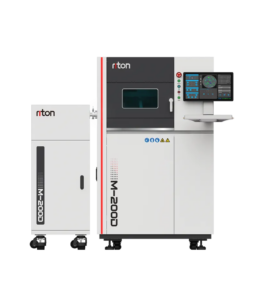
Our M-200D uses a 150 × 220 mm melting area with a 140 mm build height. Its build height represents a 40% increase. The machine uses dual fiber lasers, with each laser offering output power of up to 500 W, while its maximum melting speed reaches 14,000 mm/s.
Material Compatibility Is Critical
Dental applications require materials selected according to the intended restoration and manufacturing requirements. We therefore consider alloy compatibility one of the fundamental criteria when evaluating a metal printing platform. A printer designed around dental production should offer materials appropriate for common dental manufacturing workflows.
Our M-200D supports CoCr and titanium. For titanium printing, the machine incorporates a glove box and explosion-proof circulation system. Across our broader metal-material portfolio, we provide CoCr, titanium, and NiCr powders developed for SLM applications in dentistry, with properties including high strength, corrosion resistance, deformation resistance, and biocompatibility.
A Cleaner Printing Environment Supports Quality
Laser metal printing requires controlled processing conditions because the interaction between laser energy, metal powder, and protective gas directly affects the build environment. We therefore designed the M-200D with features intended to support cleaner and more consistent printing.
The M-200D uses nitrogen or argon as protective gas and incorporates uniform airflow for cleaner builds. It also features a permanent filter with back-blowing, which Riton identifies as a way to reduce production costs. These environmental and filtration features are important when laboratories assess long-term operating requirements rather than focusing only on laser specifications.
Intelligent Software Improves Production Visibility
A high-performance printer still needs effective process management. We believe software should give operators a clear understanding of machine status, printing progress, and potential problems throughout production. This can make digital manufacturing easier to monitor and manage across daily laboratory operations.
Our Riton Controller provides real-time monitoring of equipment operation and printing status, intuitive displays of component states, rapid fault diagnosis, and tools for viewing key printing information. It also supports customizable editing of printing content and intelligent print resumption. These capabilities help connect the physical printing system with a more controlled digital workflow.
What Top Metal 3D Printing Companies Should Provide
When we compare top metal 3D printing companies, we believe buyers should evaluate the complete manufacturing ecosystem rather than a single machine specification. Equipment, compatible materials, software, application experience, training, and technical support all influence whether a printer can deliver sustainable value in a dental laboratory.
Our experience is rooted in both laser engineering and dentistry. Riton was established in 1997, and we developed and launched China’s first metal 3D printer dedicated to dental restoration in 2016. By 2026, we had established cooperation with nearly 3,000 dental laboratories, with more than 5,000 Riton devices in use worldwide.
Connecting Precision With Production Efficiency
For us, suitability means balancing precision with commercially useful throughput. The M-200D can produce up to 430 crowns or 35 partial frameworks in 5.5 hours. Actual production time can vary according to material, build arrangement, parameters, and operating conditions.
The machine also provides a 20–60 μm layer thickness range and a 1.064 μm laser wavelength. With a 4 kW, 220 V power supply and a stated operating environment of 15–35°C with humidity up to 95% and no vibration, laboratories can assess whether the system fits their facility requirements before implementation.
Building a More Complete Digital Dental Workflow
A suitable laser metal 3D printer should ultimately contribute to a complete digital production strategy. We approach this through an ecosystem that combines metal and resin 3D printers, dental materials, software, and supporting equipment. This allows us to address different stages of dental manufacturing instead of treating the printer as an isolated piece of hardware.
Choosing Technology That Supports Dental Growth
For dental laboratories, selecting metal additive manufacturing equipment is a strategic production decision. We believe the right system should combine appropriate laser performance, build capacity, dental-specific materials, controlled airflow, intelligent software, and dependable application expertise.
As digital dentistry continues to evolve, Riton remains committed to helping dental laboratories transform digital designs into reliable metal production workflows through purpose-built additive manufacturing technologies. Contact our team to explore how Riton’s metal 3D printing solutions can support your laboratory’s next stage of digital manufacturing.