Dental laboratories are under constant pressure to improve productivity, consistency, and turnaround times while managing increasingly customized restoration requirements. Traditional manufacturing remains valuable, but digital workflows are changing how we approach metal dental production.
With SLM technology, we can manufacture complex metal components directly from digital designs and integrate production more closely with CAD/CAM workflows. As a pioneer in dental metal additive manufacturing, we at Riton see SLM metal 3D printing as an important step toward more efficient digital dentistry.
Why SLM Metal 3D Printing Fits Digital Dentistry
Selective Laser Melting, or SLM, uses a laser to selectively melt metal powder layer by layer according to digital data. For dental laboratories, this means production can begin with a digital design rather than relying entirely on conventional physical manufacturing processes.
We can therefore move from digital design to physical production with fewer disconnected steps. This is particularly useful for customized dental restorations, where each case may have different geometries. Riton’s metal 3D printers are specifically developed for dental metal restoration production, supporting a digital manufacturing approach for modern laboratories.
Greater Flexibility for Customized Dental Production
Traditional manufacturing methods can involve multiple stages, specialized tooling, and manual intervention. These requirements may become more complicated when we need to produce customized components in different geometries or small production batches.
SLM offers a different approach. We can modify the digital design and send the updated data to the printer without redesigning physical tooling. This flexibility can make additive manufacturing attractive for dental laboratories handling customized restoration work and changing production requirements.
Riton has focused on dental metal 3D printing for years. In 2016, we developed and launched China’s first metal 3D printer dedicated to dental restoration, the D-280. Our subsequent portfolio has expanded to include multiple metal printing systems for different dental production needs.
Production Efficiency Can Improve with Digital Workflows
Efficiency is another important reason laboratories evaluate SLM technology. Traditional production can require several separate manufacturing and processing stages. By contrast, additive manufacturing can consolidate the creation of complex geometries into a digital production workflow.
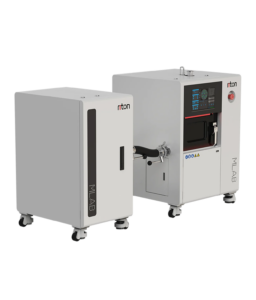
Our MLAB demonstrates how this approach can work on a compact scale. The desktop SLM metal 3D printer has a melting area of Φ100 × 90 mm, including the build plate, and production of up to 100 crowns or seven frameworks in 2.5 hours in the fastest case. Actual production time varies according to operating conditions, so laboratories should use these figures as a reference rather than a universal production guarantee.
Compact Equipment Can Reduce Space Constraints
Floor space is a practical consideration for many dental laboratories. Large industrial equipment may require substantial dedicated space, which can make technology upgrades difficult for smaller facilities or laboratories starting their digital transformation.
MLAB was developed to address this type of requirement. Its printer dimensions are 610 × 615 × 890 mm, while its compact desktop configuration makes it easier for us to consider metal additive manufacturing within an existing production environment. The machine weighs 150 kg and operates with nitrogen or argon as protective gas.
Material Compatibility Matters as Much as the Printer
A metal printer should never be evaluated independently from its material ecosystem. We need to ensure that the available alloys correspond to the intended dental applications and that the supplier has appropriate material expertise.
Riton’s metal material portfolio includes CoCr, titanium, and NiCr powders developed specifically for dental applications. The company describes these materials as offering characteristics including high strength, corrosion resistance, deformation resistance, and biocompatibility. MLAB itself supports CoCr alloy and titanium alloy according to its published specifications.
Software and Support Complete the SLM Workflow
Digital production is not simply about installing a printer. We also need software, process control, technical support, and operator training to achieve a dependable workflow.
Riton Controller provides real-time machine and printing-status monitoring, printing-content editing, intelligent print resumption, progress tracking, and automatic printing logs. We can also access software operation training, customized printing parameter support, and online or offline technical assistance. These capabilities help connect the printer with the broader production process.
Why Dental Labs Should Consider SLM Today
When we compare top metal 3D printing companies, we should evaluate more than laser specifications or equipment price. The stronger question is whether the supplier can support the complete digital manufacturing workflow, including equipment, materials, software, training, and future expansion.
At Riton, we combine decades of laser engineering experience with specialized dental additive manufacturing expertise. Our ecosystem includes SLM metal and resin 3D printers, dental materials, cloud-based design platforms, automatic wire-bending equipment, and professional services. With MLAB, we offer a compact option that combines a 250W single fiber laser, 20–60 μm layer thickness, and dental metal production capabilities.
For laboratories moving toward digital production, SLM is not simply an alternative manufacturing technique. It can become a foundation for more flexible, digitally connected, and scalable dental manufacturing. By selecting the right technology partner and evaluating the entire ecosystem, we can make additive manufacturing a practical part of our long-term production strategy.