Dental manufacturing is moving toward workflows that combine digital design, automated production, and highly customized restorations. For us, this shift raises an important question: can powder bed fusion become the foundation for high-precision dental manufacturing?
Selective Laser Melting (SLM), a powder bed fusion process, is already helping dental businesses produce complex metal components with controlled, repeatable workflows. Its potential becomes clearer when we evaluate precision, productivity, materials, and the complete production ecosystem.
Why Powder Bed Fusion Metal 3D Printers Fit Dental Production
Powder bed fusion Metal 3D machine works by selectively processing successive layers of metal powder with a high-energy laser. SLM, specifically, melts the powder layer by layer to create a solid three-dimensional component. For dental laboratories, this approach supports the production of customized geometries that can be difficult or inefficient to manufacture using conventional subtractive methods.
We should also distinguish the technology from the broader category of metal 3D printing. Powder bed fusion systems are built around controlled powder spreading, laser exposure, thermal management, and process parameters. When these elements are optimized together, the process can support the precision and repeatability demanded by digital dental production.
What Should We Expect from Top Metal 3D Printing Companies?
When comparing top metal 3D printing companies, we should look beyond laser wattage or headline production speed. Dental applications require a complete combination of equipment engineering, material compatibility, software, process development, and technical support.
Since entering the dental 3D printing field, we have focused on advancing metal additive manufacturing technologies for clinical and laboratory applications. In 2016, we introduced our first metal 3D printer dedicated to dental rehabilitation, marking an important step in our journey toward digital dental manufacturing.
For us, this industry-specific experience is important because a machine designed around dental production can address workflow requirements more directly than a general-purpose metal printer.
How the Riton M-150 Supports Precision and Productivity
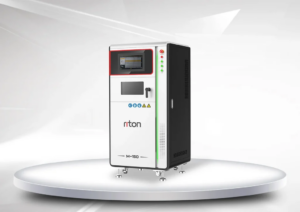
Riton’s M-150 is an SLM metal 3D printer specifically designed for dental metal restoration production. Its published specifications include a single fiber laser with output power of up to 500W, a laser wavelength of 1.064 μm, scanning speed of up to 14,000 mm/s, and a melting area of Φ150 × 140 mm, including the build plate.
The system also supports 20–60 μm layer thickness and uses nitrogen or argon as protective gas. Riton lists CoCr alloy and titanium alloy among its compatible melting materials. For a dental laboratory, these specifications provide a practical foundation for evaluating whether the printer matches our required restoration types, batch sizes, and material strategy.
Productivity is equally important. The M-150 can print 200 metal crowns or 17 frameworks in 4.5 hours. Actual production time can vary according to operating conditions, so we should use this figure as a reference point when modeling capacity rather than treating it as a universal guarantee.
Precision Comes from Multiple Technologies Working Together
High precision cannot be attributed to the laser alone. A reliable powder bed fusion workflow depends on the interaction between the forming chamber, optical system, scanning strategy, powder spreading, and support structures.
Riton’s M-150 uses an optimized forming chamber, adjustable optical path, spot compensation, multi-pass contour outlining, island scanning, regional filling, and multiple support composite structures. We believe these technologies can help work together to maintain the precision and quality of printed products.
This system-level approach matters to us because dental production involves highly customized components. Consistent process control can help us reduce the risk of quality variation while maintaining a repeatable workflow across multiple production cycles.
Materials and Infrastructure Matter Too
A high-performance printer is one part of a powder bed fusion operation. We need to evaluate compatible powders, protective gas, powder recovery, post-processing, and facility requirements before purchasing equipment.
Infrastructure also requires planning. Our service documentation specifies requirements for site conditions, environmental control, power, gas, and water. For titanium production, additional requirements apply to gas purity, powder handling, circulation, post-processing, and safety. This reinforces why we should assess the entire workflow rather than the printer in isolation.
Is Powder Bed Fusion the Future of Dental Manufacturing?
Powder bed fusion is not automatically the answer for every dental application, but its combination of digital customization, metal processing, precision, and scalable production makes it a strong candidate for the future of high-precision dental manufacturing.
At Riton, we apply SLM technology specifically to dental metal restoration production and support it with dedicated materials and digital workflow solutions. The M-150 provides a compact platform with a 150 × 140 mm melting area and production capability designed around dental applications.
For us, the future is therefore less about choosing a printer based on specifications alone and more about building a reliable digital manufacturing system. By combining powder bed fusion with appropriate materials, process control, software, and technical support, we can move closer to efficient, repeatable, and scalable dental production.