Dental laboratories are under constant pressure to produce customized restorations with greater speed, consistency, and cost control—but for smaller labs, the constraints of floor space, equipment budgets, and technical expertise make this particularly acute. We believe desktop metal additive manufacturing is fundamentally shifting this dynamic.
What was once primarily associated with large-scale industrial systems, selective laser melting (SLM) is now available in a compact desktop format, bringing controlled inert atmospheres and powder-handling capabilities into a smaller footprint suitable for space-constrained dental labs. This compact design makes metal additive manufacturing more accessible, helping small dental labs bring more production in-house, reduce reliance on outsourcing, and maintain a digital workflow from intraoral scanning to final delivery.
Why Compact Metal Printing Matters to Small Labs
Traditional industrial metal additive manufacturing systems can demand substantial space and infrastructure. Small dental laboratories may therefore hesitate to adopt metal printing even when the technology could improve their production model. A compact machine changes the investment conversation by reducing the physical footprint required for metal additive manufacturing.
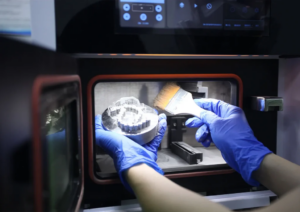
Our MLAB is designed specifically around this requirement. The printer occupies about 0.36 m², with a machine size of 610 × 615 × 890 mm and a weight of 150 kg. Its compact design allows labs to make better use of constrained production areas without treating metal printing as an exclusively large-facility technology.
From Digital Files to Dental Metal Parts Faster
Speed matters because dental labs operate around demanding case schedules and personalized orders. The value of a metal printer is not simply its ability to produce a part, but its ability to integrate efficiently into the lab’s digital production chain.
MLAB uses a single 250W fiber laser, supports a maximum scanning speed of 11,200 mm/s, and offers a layer thickness range of 20–60 μm. Its melting area is Φ100 × 90 mm, including the build plate. For dental production, Riton specifies a fastest-case productivity of 100 crowns or seven frameworks in 2.5 hours, although actual time varies with operating conditions.
Precision and Process Control for Dental Applications
Small laboratories cannot afford to sacrifice consistency for compact equipment. We therefore focus on process control as much as machine size. MLAB incorporates powder quantity monitoring and an optimized powder-spreading distance to support both efficiency and precision.
The system also features remote printing-data transmission and an upward powder-feeding structure. Together, these functions are designed to streamline material handling and printing operations. MLAB supports CoCr alloy and titanium alloy, giving dental labs access to metal materials suited to different production requirements.
Making Metal AM More Practical for Growing Teams
Adopting new manufacturing technology involves more than purchasing hardware. Operators need a manageable interface, predictable workflows, and technical support that can reduce the learning curve. This is especially important for smaller labs where a limited team may be responsible for multiple production stages.
MLAB includes Riton Controller, our control software designed to provide real-time machine status and printing-progress feedback. We also provide installation consulting, equipment and site planning, professional training, and after-sales technical support. This broader approach helps small labs build operational capability alongside their equipment investment.
How Leading 3D Printer Manufacturers Can Support Scalable Growth
For small dental labs, selecting among leading 3D printer manufacturers should involve more than comparing laser power or headline productivity. Buyers should evaluate the complete workflow: material compatibility, machine footprint, process monitoring, software, training, service, and the manufacturer’s experience in dental applications.
We have focused on dental additive manufacturing for decades and pioneered the application of metal 3D printing in China’s dental sector. Today, our portfolio extends beyond metal printers to resin 3D printers, auxiliary equipment, metal and resin materials, software platforms, and digital dental solutions. This enables us to approach equipment as part of a connected production system rather than an isolated machine.
Why Desktop Metal Printing Is a Strategic Step Forward
The transformation created by desktop metal printing is ultimately about accessibility. Smaller dental labs can consider bringing metal production closer to their own workflows instead of relying entirely on external manufacturing capacity. That can support shorter production cycles, more direct process control, and greater flexibility for customized dental work.
Our MLAB reflects this direction. Its compact footprint, dental-focused productivity, process-monitoring functions, compatible metal materials, and integrated control software are designed to make metal additive manufacturing more approachable. The fastest stated production cycle of 2.5 hours for 100 crowns or seven frameworks, together with a 17% efficiency improvement over our D-100 small metal printer, demonstrates how compact equipment can still pursue meaningful production performance.
Building the Next Generation of Small Dental Labs
Desktop metal printing is no longer only a technology discussion for large manufacturing centers. For small dental labs, it can become a practical tool for improving production flexibility, digital integration, and capacity. We at Riton continue to develop dental 3D printing solutions that combine equipment, materials, software, training, and technical support. As labs seek more responsive and digitally connected production, we believe the desktop 3D metal printer will play an increasingly important role in their growth.