Buying a metal 3D printer is a production decision, not simply a hardware purchase. Dental laboratories and other precision manufacturers need to compare machine architecture, laser performance, build capacity, material compatibility, workflow integration, and supplier support.
When we evaluate top metal 3D printing companies, we should also consider whether a system fits our actual production environment. Riton approaches metal additive manufacturing from a dental-focused perspective, combining printers, materials, software, and services into a broader digital workflow.
Look Beyond the Headline Specifications
When comparing top metal 3D printing companies, we first examine the specifications that directly influence production. Laser source and power, scanning speed, build or melting area, layer thickness, protective atmosphere, and compatible powders all deserve attention. These parameters help us understand whether a printer can match the required application and production volume.
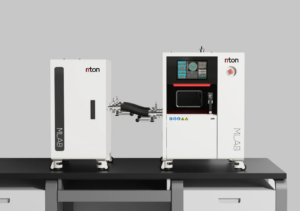
We should also distinguish maximum specifications from real operating conditions. Riton’s MLAB, for example, uses a single fiber laser with 250W laser power and a maximum scanning speed of 11,200 mm/s. Its melting area is Φ100 × 90 mm, including the build plate, while layer thickness is adjustable from 20–60 μm. The system can print 100 crowns or seven frameworks in 2.5 hours in the fastest case, although actual time varies by conditions.
Assess the SLM Metal 3D Printer’s Material Compatibility
Material compatibility is another essential purchasing criterion. A metal printer should support the alloys required for our intended applications, and the supplier should provide a clear material ecosystem rather than leaving us to solve compatibility questions independently.
The MLAB SLM metal 3D printer supports CoCr alloy and titanium alloy. This is particularly relevant to dental laboratories considering metal additive manufacturing for restoration-related production. We have also developed a broader dental materials portfolio that includes CoCr, titanium, and NiCr alloy powders, alongside dental resins for other digital workflows.
Match the Machine to Our Production Environment
A high-performance printer is not automatically the right printer. We need to consider available floor space, production scale, infrastructure, operator experience, and the type of work being produced. A compact system can be valuable when a laboratory needs metal printing capabilities but cannot accommodate a large industrial machine.
MLAB was developed as a desktop metal 3D printer with a compact design. Its published dimensions are 610 × 615 × 890 mm, and the printer weighs 150 kg. It uses nitrogen or argon as protective gas and requires an operating environment of 15–35°C with humidity of no more than 95% and no vibrations. These details should be reviewed against our facility before purchase.
Evaluate Software and Workflow Integration
The printer itself is only one part of a digital production chain. We should examine how the machine handles printing preparation, monitoring, data transfer, and production management. Software integration can influence operator efficiency and help us manage a repeatable workflow.
MLAB includes Riton Controller, Riton’s control software for its metal 3D printers. The software can support functions such as machine-state monitoring, printing-content editing, intelligent print resumption, printing-progress tracking, and automatic printing logs. For production teams, these functions can provide greater visibility into machine operation and simplify routine management.
Compare Supplier Experience and Long-Term Support
Equipment investment also creates a long-term relationship with the manufacturer. We should therefore evaluate technical expertise, application knowledge, training, service capabilities, and the supplier’s history in the target industry rather than focusing only on the initial equipment price.
Riton was established in 1997 and developed China’s first metal 3D printer dedicated to dental restoration, the D-280, in 2016. The company later expanded its metal printer portfolio to include models such as D-120, D-100, D-150, TI-150, DUAL-150, DUAL-200, M-150, and MLAB. More than 5000 of our metal 3D printers are in installation worldwide.
Consider the Complete Digital Dental Ecosystem
For dental laboratories, the strongest supplier may be the one that can support more than the printer itself. Riton provides an integrated digital dental ecosystem covering metal and resin 3D printers, automatic orthodontic wire bending machines, clinical-grade materials, cloud design platforms, and training services.
This broader approach can help us build a connected workflow instead of managing unrelated technologies from multiple sources. When evaluating top metal 3D printing companies, we should therefore ask whether the manufacturer can support our current application and provide a practical path for future expansion.
Make the Purchase Based on Production Fit
Choosing a metal 3D printer should ultimately come down to production fit. We need to compare technical specifications, compatible materials, physical requirements, software, application experience, and ongoing support together. A lower purchase price may not represent better value if the machine cannot integrate efficiently into our workflow.
As a dental-focused additive manufacturing company, we at Riton combine metal printing expertise with materials, software, and digital dentistry solutions. Our MLAB offers a compact SLM metal 3D printing option with a 250W single fiber laser, 20–60 μm layer thickness, and support for CoCr and titanium alloys. For laboratories evaluating their next investment, we recommend comparing the complete ecosystem—not just the machine on the quotation.