Dental laboratories increasingly need to produce accurate models while managing growing case volumes and shorter delivery expectations. We see UV resin 3D printing as an important technology for meeting these demands because it combines digital design with rapid photopolymerization and detailed layer-by-layer fabrication. For dental companies evaluating a dental resin 3D printer, the real value lies in achieving repeatable detail, efficient production, and a workflow that can scale with changing business requirements.
How UV Resin 3D Printing Works for Dental Production
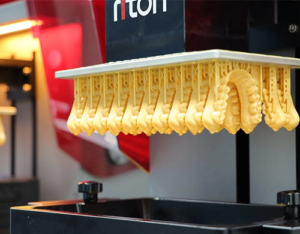
UV curing uses liquid photosensitive resin that reacts when exposed to a specific ultraviolet light source. The resin is selectively cured layer by layer, gradually building the digital design into a solid three-dimensional model. This process enables dental laboratories to move directly from digital data to physical models with fewer conventional manufacturing steps.
We design our resin printing solutions specifically around dental production. Our current portfolio includes the RXDent-L230, RXDent-L130 Ultra and RXDent-D130 resin 3D printers, supported by dental-specific UV-curing materials. This combination allows laboratories to choose equipment and consumables according to their application, production scale, and workflow requirements.
High Resolution Supports Detailed Dental Models
Precision is fundamental when a printed model is used to evaluate dental anatomy, orthodontic treatment, or restorative workflows. Small geometric differences can affect how effectively a model supports downstream processes. We therefore focus on the relationship between printer resolution, material behavior, and finished surface quality rather than treating resolution as an isolated specification.
Our RXDent-L230 offers a molding size of 228 × 128 × 150 mm, a 30 μm pixel size, and 7680 × 4320 pixel resolution. These specifications are designed for high-precision production while providing a relatively large molding area for dental applications. Such capacity can help laboratories organize multiple models within a production cycle.
Dental Resin 3D Printer Applications Beyond Basic Models
A modern dental resin 3D printer should support more than one type of model. Dental laboratories may need materials for orthodontic models, surgical guides, gingiva masks, splints, try-ins, denture bases, trays, and other specialized applications.
We have developed a broad resin-material portfolio around these requirements. Riton’s dental resin range includes dedicated materials for dental models, surgical guides, gingiva masks, casting wax, IBT, splints, try-ins, denture bases, trays, crown bridges, crowns, and denture teeth. This application-specific approach helps laboratories match resin properties with the intended production task.
Material Selection Directly Affects Production Results
Printer performance is only one part of high-precision dental manufacturing. The resin itself must provide properties appropriate for the intended application, while its wavelength compatibility and processing characteristics must match the printing system.
For example, our Model V1.0 dental model resin is designed for dental models and supports 385–405 nm wavelengths on LCD/DLP equipment. This model specifies dimensional stability, surface hardness, detailed reproduction, and fast molding as key features. Its hardness is ≥82 Shore D, while water absorption is specified at ≤1.2%.
Why Production Efficiency Matters to Dental Labs
Precision becomes commercially valuable when laboratories can reproduce it consistently at an appropriate production speed. We therefore consider throughput, cleaning requirements, post-processing, and material availability alongside printer resolution when developing dental workflows.
Riton’s resin printing process includes filling the resin tank, layer-by-layer UV curing, cleaning the printed model with isopropyl alcohol, UV post-curing, and final support removal and surface finishing. Understanding the complete process helps production teams establish repeatable procedures instead of evaluating the printer solely on its headline resolution.
What to Look for When Comparing Dental Resin Solutions
When we compare dental resin systems, we look at the entire ecosystem: printer architecture, molding size, pixel resolution, compatible materials, application coverage, post-processing equipment, training, and technical support. These factors have a direct impact on whether the technology can become a dependable part of daily production.
Riton provides both resin printing equipment and dedicated dental materials, alongside auxiliary equipment such as the RXDent-W150 ultrasonic cleaner. We also provide printer-operation and post-processing training, online technical support, and repair services to help laboratories maintain production continuity.
Building More Capable Digital Dental Workflows
For us, UV resin 3D printing is most valuable when it becomes part of an integrated digital production strategy. Riton was founded in 1997 and has developed an ecosystem spanning metal and resin 3D printers, dental materials, auxiliary equipment, wire bending technology, and digital platforms. We have also expanded our resin portfolio to address different dental applications rather than relying on one universal material.
Turning Digital Dental Data Into Production Value
High-precision dental models require more than a high-resolution printer. They depend on compatible materials, controlled processing, suitable post-processing, and a workflow that can deliver consistent results at commercial volumes. We believe Riton’s combination of resin printers, application-specific materials, and production support gives dental laboratories a practical route toward this goal. By integrating UV resin 3D printing into digital production, laboratories can create detailed models more efficiently while preparing their operations for continued growth.